

Board Performance · 2025
In this section15 topics
- Compliance Monitoring — Overview1 item
- Prevention of Conflicts of Interest3 items
- Prevention of the Use of Inside Information3 items
- Anti-Corruption5 items
- Whistleblowing4 items
- Selection of Directors & Chief Executives5 items
- Selection of Independent Directors2 items
- Director Development1 item
- Evaluation of Board & Subcommittee Performance2 items
- Subcommittees1 item
- Meeting Attendance & Remuneration3 items
- Supervision of Subsidiaries & Associated Companies4 items
- Board Duty Performance — Overview1 item
- Audit Committee Duty Performance1 item
- Executive Committee Duty Performance1 item
Compliance Monitoring — Overview
Monitoring of Compliance with Other CG Policies & Guidelines
Disclosure and Transparency
The company has a policy to disclose data and information accurately, adequately and in a timely manner to allow stakeholders the opportunity to know about our operating performance, financial position, key developments and important information such as financial statements, annual report and disclosure Form 56-1, in both Thai and English language. Such information is available on the websites of relevant authorities such as the Stock Exchange of Thailand (SET) and the Securities Exchange Commission (SEC) as well as on the company’s website www.deltathailand.com. Interested persons may telephone or email the company to request for more information at info@deltathailand.com. The company also has an investor relations unit to provide information to shareholders, investors, securities analysts and other parties, which can be reached at IR.TH@deltaww.com
The company has organized a quarterly press conference to announce and explain each quarter's consolidated financial data, business performance and future plans to securities analysts, reporters and general investors. The meeting is also a chance for stakeholders to meet with our top management and build confidence in the company. Analyst meetings are arranged every quarter. In addition, private meetings upon investor’s requests are also arranged by our Investor Relations unit to establish a better understanding of the company’s operation and its business strategies.
The IR manager represents our management in regional conferences several times a year to provide updated information on the company’s operation and business outlook. In 2025, the company organized various activities as followed;
Meeting with Foreign Investors 28 Times | Meeting with Local Investors 4 Times |
Meeting with Analyst 12 Times | Opportunity Day organized by SET 4 Times |
International Conference 46 Times | Domestic Conference 40 Times |
Prevention of Conflicts of Interest
Has the Company Acted to Prevent Conflicts of Interest?
Yes
Operations in the Past Year
In general practice, decision making by the directors and executives must ultimately be done in a way that benefits the company. In the case of a conflict of interest, the directors or executives shall submit the issue to the Board or the shareholders’ meeting to consider the necessity of executing such a transaction and the potential impact on the company if the matter approved. At the time of voting on the issue, a person with a conflict of interest is not allowed to vote. The directors and executives of the company have filed both their personal and their related persons’ report on personal interests regarding the company, with an extra copy for the Chairman and Audit Committee Chairperson of the company, through the Company Secretary. Such reports are required to be updated annually and submitted to the company. In addition, employees who may have conflicts of interest with the company (as stated in the Conflict-of-Interest Declaration) are required to disclose any relationships that could create a conflict of interest with the company every year. The company also deals with related party transactions as regulated by the Capital Market Supervisory Board and also disclosed inter-transactions with its affiliates in the company’s financial statements and in the annual information disclosure Form 56-1 One Report.
In addition to requiring the directors and executives of the company to file both their personal Interest Report and that of their related persons submitting an extra copy to the Chairman and the Audit Committee Chairperson through the Company Secretary each year, the company also monitors compliance with the policy to avoid conflicts of interests in accordance with the Code of Conduct, the directors, managements and employees are required to attend the 'Integrity/RBA/CoC' training course and pass a 100-point test each year. In addition, all monthly staff must make a self-declaration in your conflicts of interest with the company in annual “Conflicts of Interest Declaration Report” to ensure that they will perform their duties fairly and impartially in accordance with the company's Code of Conduct which includes the following topics:
Avoidance of family conflict of interest
Avoidance of conflict of interest by having relatives involved in company business transactions
Avoidance of conflict of interest in personal business/investment activities
In cases where employees report a conflict of interest, the supervisor or manager, along with HR, should conduct a risk assessment and identify the best solutions for both the company and the employees.
Number of Conflict-of-Interest Cases
| Metric | Current Year | Previous Year | Two Years Ago |
|---|---|---|---|
| Total number of cases or issues related to conflicts of interest (cases) | 0 | 0 | 0 |
Prevention of the Use of Inside Information
Has the Company Acted to Prevent the Use of Inside Information?
Yes
Operations in the Past Year
Under the company’s policy, insider information is restricted to executives from the middle to the top levels. All employees are strictly prohibited from using company’s documents or information for personal use, or taking them outside the company. Use of inside information without permission or that leads to any damage is deemed serious wrongful conduct with regards to the equitable treatment and protection of shareholders. The policy prohibiting the use of inside information for securities trading is clearly outlined in the company’s Code of Conduct Guidelines, which has been published on the company’s intranet and e-learning portal to ensure awareness among directors, executives and employees. In order to comply with the use of internal data policy. The Company Secretary Department informs directors, executives, and employees who have access to inside information in advance via e-mail of the Blackout Period, which is a one-month period prior to the announcement of the Company’s quarterly operating results.
Moreover, the company has a policy that its directors and executives must disclose information on the securities held by themselves (including their spouses and minor children) to the Office of the Securities and Exchange Commission (the Office of the SEC) within 3 days after the change of ownership of securities has taken place and inform the company's secretary so they can report the Board of Directors accordingly.
To provide guidelines on preventing the use of inside information, all directors, executives, and employees are required to attend the online training course '8-Min Delta's Essential Code of Conduct,' which covers 'Insider Trading,' and complete the assessment form with a minimum score of 90 points. The training was attended by 100% of directors, executives, and employees.
Number of Inside-Information Cases
| Metric | Current Year | Previous Year | Two Years Ago |
|---|---|---|---|
| Total number of cases or issues related to the use of inside information to seek benefits (cases) | 0 | 0 | 0 |
Anti-Corruption
Has the Company Acted on Anti-Corruption?
Yes
Operations in the Past Year
Announcement Policy:
The Board of Directors has approved the adoption of an Anti-Corruption Policy in order to establish principles, set practice guidelines, arrange communication and provide training in the area of anti-corruption and signed on declaration of intent in establishing Thailand’s Private Sector Collective Action against Corruption (CAC) on 16 July 2018. At present, the company has submitted an application for the third renewal of certification in December 2025.
Operations:
The company established an Anti-Corruption Procedure to guidelines to work against corruption, which consists of implementation, risk assessment, auditing, monitoring, whistleblowing, investigation, and the punishment process, and announced it on the company's internal website. Our Anti-Corruption commitment program ensures employees are aware of their duties and responsibilities and perform their jobs with honesty and integrity.
Supervision:
Anti-Corruption Committee: Oversees, provides guidance, monitors, and evaluates the implementation of anti-corruption practices in accordance with established policies. The Committee conducts an annual review of the policies to ensure they remain appropriate and aligned with evolving risks
Audit Committee: Responsible for overseeing the internal control system to ensure that anti-corruption measures are adequate and effective. The Committee reviews risk assessments and provides recommendations to the Board of Directors.
Management: Responsible for establishing guidelines for assessing corruption risks within operational processes, reviewing the adequacy and appropriateness of related processes and control measures, and communicating these requirements to employees and all relevant stakeholders.
Risk Assessment: All departments, including subsidiaries, are required to conduct an Annual Integrity Risk Assessment to identify risks and review the adequacy and appropriateness of existing processes and control measures.
Adequacy and Effectiveness Review: The Internal Audit Department conducts reviews of compliance with established measures and reports the results to the Audit Committee.
Training and Awareness: Training programs are provided for both new and existing employees on the Code of Ethics, relevant guidelines, and anti-corruption prevention practices.
Whistleblowing Channels: Multiple channels are established for employees and stakeholders to report concerns or complaints via email, telephone, or the Company’s website, supported by a whistleblower protection mechanism.
Disciplinary Measures: Strict disciplinary actions are taken against individuals who violate Company policies, ranging from warnings to termination of employment.
Other Operations:
The company initiated an agreement between the purchasing department and suppliers named The Procurement and Supplier Covenants in 2001 and later changed it to Integrity Undertaking to build a healthy procurement system and avoid the negative influence of human factors and reduce the risk on normal business. The agreement is an acknowledgment by both parties to do business with integrity and without bribery or any unwarranted returns.
The company has issued a letter to its suppliers and partners requesting their cooperation in complying with the Company's anti-corruption guidelines. in the following aspects
1. Avoid conflicts of interest by submitting a self-report to the Company if relatives are involved in a business transaction with Delta.
2. Whistleblowing through complaint channels
3. No gift policy
The company seeks cooperation from suppliers not to send any gift/gratuity to company management, employees or their family members during New Year and other festival occasions.
All monthly-salaried employees at levels A1–M6 are required to formally acknowledge and sign the Code of Conduct and the Anti-Corruption Policy.
The company organizes a “Supplier Day” to communicate its Code of Conduct, reinforcing that all business operations must be conducted with integrity and ethical standards. The company clearly declares that it will not engage in any transactions with agents, distributors, or organizations that operate without integrity.
Directors, executives, and employees are required to complete the training course “Group Code of Conduct (Integrity/RBA/CoC)” and must achieve a 100% passing score annually.
Campaign on anti-corruption through company emails / Line / Facebook / Website to make employees aware of the importance of this matter regularly.
Form of Anti-Corruption Operations
| Operation |
|---|
| Review of appropriateness in anti-corruption |
| The participation in anti-corruption projects |
| Assessment and identification of corruption risk |
| Communication and training for employees on anti-corruption policy and guidelines |
| The monitoring of the evaluation of compliance with the anti- corruption policy |
| Review of the completeness and adequacy of the process by the Audit Committee or auditor |
Number of Corruption Cases
| Metric | Current Year | Previous Year | Two Years Ago |
|---|---|---|---|
| Total number of cases or issues related to corruption (cases) | 2 | 3 | 3 |
Details of Corruption Cases
| Status | Period Type | Start of Period | End of Period | Details of the Case or Issue | Investigation Results | Corrective Actions |
|---|---|---|---|---|---|---|
| Incident no longer subject to action | month/year Range | 2021-01 | 2021-12 | A payment from a supplier to the employee’s bank account was detected. | The supplier claimed that the funds were provided to the employee as a loan; however, no supporting loan documentation was presented. | The Company terminated its business relationship with the supplier and dismissed the employee from employment. |
| Incident no longer subject to action | month/year Range | 2025-01 | 2025-12 | The employee used his position to seek personal benefits by selling products from a company in which he is a shareholder to the Company. | It was found that the misconduct was substantiated. | The Company terminated its business relationship with the supplier and dismissed the employee from employment. |
| Incident no longer subject to action | month/year Range | 2021-01 | 2021-12 | Found transactions with an employee described as “making merit”. | Based on the review, these transaction were assessed as charitable rather than bribe. | Written warning
|
Whistleblowing
Has the Company Implemented Whistleblowing Procedures?
Yes
Operations in the Past Year
The company has a Whistle Blowing Policy to support and encourage employees and stakeholders to make complaints about misconduct. With the policy, complainants can provide information concerning wrongful acts including any unlawful activity or any behavior against the company rules and/or Code of Conduct to the management or Board of Directors. This is to ensure the company's transparent and efficient operations. The company has established the following communication channels to allow all employees and stakeholders to provide feedback or file complaints concerning this issue.
Communication Channel for Delta Employees
Head of the unit where the employee belongs to
Email: Report.it@deltaww.com
Communication Channel for other Stakeholders
Email: whistleblow@deltathailand.com
In order to ensure that the system remains secure, confidential and independent for anonymous disclosure, we have contracted with an independent third-party whistleblowing provider. You can use the below email and website to report the concerns regarding ethics, misconduct, fraud, and other violations of company policies.
Email: delta@whistleblowing.link
Website: https://delta.whistleblowing.link/
Mailing Address: P.O Box 241 Phra Khanong Post office Bangkok Thailand 10110
Depending on the relevance of the complaints, the Board's Secretary will gather and submit the complaints to the Anti- Corruption Committee, the Executive Committee, the Audit Committee or the Board. The company has established a policy to protect the complainant, the details of the complaint will be kept confidential and get appropriate protection in order to avoid an infringement of privacy.
At the Board of Directors Meeting No. 2/2026, the Board Secretary informed the Board that the company has continued monitoring business ethics violations. Further evidence and additional offenders were identified, prompting an investigation. In 2025, additional evidence and individuals involved were identified, leading to the investigation of three cases. The Company has taken disciplinary action against the suppliers and employees who violated the Code of Conduct and engaged in bribery.
The company has implemented corrective measures for the procurement system and introduced several proactive measures to prevent vendor and employee misconduct. These measures include online bidding, job rotation, increased interaction between top management and vendors, signing contracts to promote awareness of honesty, the establishment of a third-party whistleblower system, increasing communication channels both internally and externally, and other mechanisms aimed at fostering a culture of integrity and preventing corruption within the organization. In addition, the company has introduced rewards for whistleblowers and set a goal to eliminate corruption from the company by 2027, which will be reported to the Board of Directors.
There have been no complaints received regarding anti-trust, or fair competition.
Number of Whistleblowing Cases
| Metric | Current Year | Previous Year | Two Years Ago |
|---|---|---|---|
| Total number of cases or issues received through whistleblowing channels (cases) | 5 | 12 | 8 |
Details of Whistleblowing Cases
| Status | Period Type | Start of Period | End of Period | Details of the Case or Issue | Investigation Results | Corrective Actions | Case or Issue |
|---|---|---|---|---|---|---|---|
| Incident no longer subject to action | month/year Range | 2026-01 | 2026-01 | Misconduct by Facilites Officer | It is unable to obtain evidence from CCTV footage or witness statements to detemine the responsible for the misconduct, and therefore no disciplinary action can be taken. | 3201 · Other name: Code of Conduct · Description: Other | |
| Incident no longer subject to action | month/year Range | 2025-04 | 2025-04 | The illegal activities including underground lotteries, loan sharking and participation in a Ponzi scheme. | employees admitted their wrongdoing and voluntarily resigned. | - | 3190 · Description: Compliance with laws, regulations, and rules |
| Incident no longer subject to action | month/year Range | 2025-05 | 2025-05 | Abuse authority, Harassament | It was found that there were instances of threatening language toward employees, including claims of having the authority to dismiss employees, which caused fear among employees and created a hostile working environment. | Verbal warning and attitude adjustment | 3201 · Other name: Code of Conduct · Description: Other |
| Incident no longer subject to action | month/year Range | 2025-01 | 2025-11 | Abuse of Power | The supervisor frequently uses abusive language, displays unstable emotional behavior, and often criticizes and intimidates subordinates. | The reporting line was transferred to a new supervisor as a preventive measure to address the inappropriate conduct. | 3201 · Other name: Code of Conduct · Description: Other |
| Incident reviewed by the organization | month/year Range | 2025-11 | 2026-11 | There are concerns that HR’s recruitment process lacks transparency and fairness. | 3201 · Other name: Code of Conduct · Description: Other |
Selection of Directors & Chief Executives
Are Directors Selected Through the Nomination Committee?
Yes
Are Chief Executives Selected Through the Nomination Committee?
No
Number of Directors from Major Shareholders
3
Rights of Minority Shareholders on Director Appointment
Appointment of Directors
One share shall count for one vote and each shareholder shall exercise all the votes he has to appoint the nominated person or nominated persons to be a director on a person-by-person basis or en-bloc basis. Shareholders cannot divide votes for any person. The person obtaining the most votes in descending order shall be elected as directors equal to the number of directors required.
Method of Director Appointment
| Method |
|---|
| Method whereby each director requires approval votes more than half of the votes of attending shareholders with voting rights |
Selection of Independent Directors
Criteria for Selecting Independent Directors
Qualifications of Independent Director
Independent directors must be independent from the management and major shareholders. Qualifications of the company’s independent directors (ID) have been consistent and stricter than the requirements set by the Office of Securities and Exchange Commission as follows:
1. Not holding shares exceeding 0.5% of the total voting right shares of the company, its parent company, its subsidiary, its associated company. A person with a potential conflict of interest with any shares held by Related Persons taken into account.
2. Not being nor having been an executive director, employee, officer, monthly paid advisor or controlling person of the company, its parent company, its subsidiary, its associated company, its parallel subsidiary company. A person with a potential conflict of interest with the company. An exception would be if he/she has no such status for at least two years before becoming an independent director.
3. Not a person related by blood or by registration under the law as father, mother, spouse, sibling or child. This includes the spouse of a child of an executive, major shareholder, controlling person, or person who will be nominated to be an executive or controlling person of the company or its subsidiary.
4. Not having nor having had any business relationship with the company, its parent company, its subsidiary, its associated company. A person with a potential conflict of interest that may interfere with his/her use of independent discretion. This includes not being nor having been a major shareholder, a director who is not an independent director, or an executive of a person who has a business relationship with the company, its parent company, its subsidiary, its associated company. A person with a potential conflict of interest. An exception would be if he/she has no such status for at least two years before becoming an independent director. Details of business relations are summarized as follows:
4.1 Professional advisor
4.1.1 An auditor for any related case.
4.1.2 Advisor (such as legal advisor, financial advisor, appraiser) for transactions with a value of over THB 2
million per year.
4.2 Other business relationship
4.2.1 Scope of business covers normal business transactions, rental or lease of immovable property
transactions, asset or service transactions, and financial assistance transactions.
4.2.2 Having business relationships with either the transaction value of THB 20 million or more, or 3% or
more of its net tangible assets, whichever is lower (including transactions with the same person within
6 months).
4.2.3 The Board of Directors may exempt any transaction by an independent director with a unanimous
resolution which exceeds the above value if the case is deemed to be necessary, appropriate and
irregular. In such a case, the business transaction is required to be disclosed in the registration
statement (Form 56-1) and the annual report. If the independent director is re-appointed for another
term, such relationship or transaction must also be disclosed in the notice of meetings.
5. Not a director who is not appointed as a representative to safeguard the interests of the company’s directors, majority shareholders or shareholders who are related to the company’s major shareholders.
6. Having any other characteristics which make it impossible to express an independent opinion with regards to the company’s operations.
7. An independent director who satisfies the qualifications specified in 1 to 6 above may be empowered by the Board to make decisions in normal business operations, provided that the decision process is collective.
Selection of Directors and Independent Directors
The Board of Directors assigned the Nomination and Compensation Committee to search, select and nominate qualified candidates to be a director or member of any committee. The Board Matrix has been prepared with consideration to select people with knowledge and experience in various fields that are lacking. The committee selections are considered on the basis of whether that person is knowledgeable and experienced in areas such as accounting, finance, management, strategy and possess individual skill and expertise in line with the company’s business and strategies without restrictions on gender, race or nationality. This is in order to have board diversity and a solid company structure to achieve business objectives under management according to the principles of good corporate governance standards.
In selecting directors, the Board of Directors considers candidates with the knowledge and experience that the Board lacks and has set a target of having three female directors, or 30% of the total Board, in compliance with the Board Diversity Policy. In 2024, the Board of Directors considered appointing Mrs. Saowanee Kamolbutr, who has expertise in political science a skill still lacking on the Board and aligned with the company's business strategy as a new director, thereby achieving the target of having three female directors.
Currently, the company has provided the opportunity to the shareholders to nominate candidates to be company directors with basic qualifications set forth on the company website. The Board will consider and approve the selected candidate by majority votes of the board meeting. After selection, the Board shall nominate such a candidate to the shareholders’ meeting for approval.
Did Any Independent Director Have a Business or Professional Relationship?
No
Director Development
Qualifications for Director Selection
| Qualification | Skill & Expertise |
|---|---|
| Select people with knowledge and experience in various fields that are lacking. The committee selections are considered on the basis of whether that person is knowledgeable and experienced in areas such as accounting, finance, management, strategy and possess individual skill and expertise in line with the company’s business and strategies | 121 · Description: Automotive · 131 · Description: Energy & Utilities · 139 · Description: Electronic Components · 140 · Description: Information & Communication Technology · 141 · Description: Law · 143 · Description: Accounting · 144 · Description: Finance · 145 · Description: Corporate Social Responsibility · 147 · Description: Sustainability · 150 · Description: IT Management · 152 · Description: Data Analysis · 155 · Description: Brand Management · 159 · Description: Engineering · 158 · Description: Corporate Management · 163 · Description: Leadership · 164 · Description: Strategic Management · 165 · Description: Risk Management · 166 · Description: Audit · 167 · Description: Internal Control · 265 · Description: Governance/ Compliance · 1683 · Description: Business Administration |
Evaluation of Board & Subcommittee Performance
Criteria for Evaluating Board Performance
Assessment of the Board of Director and Sub-Committee
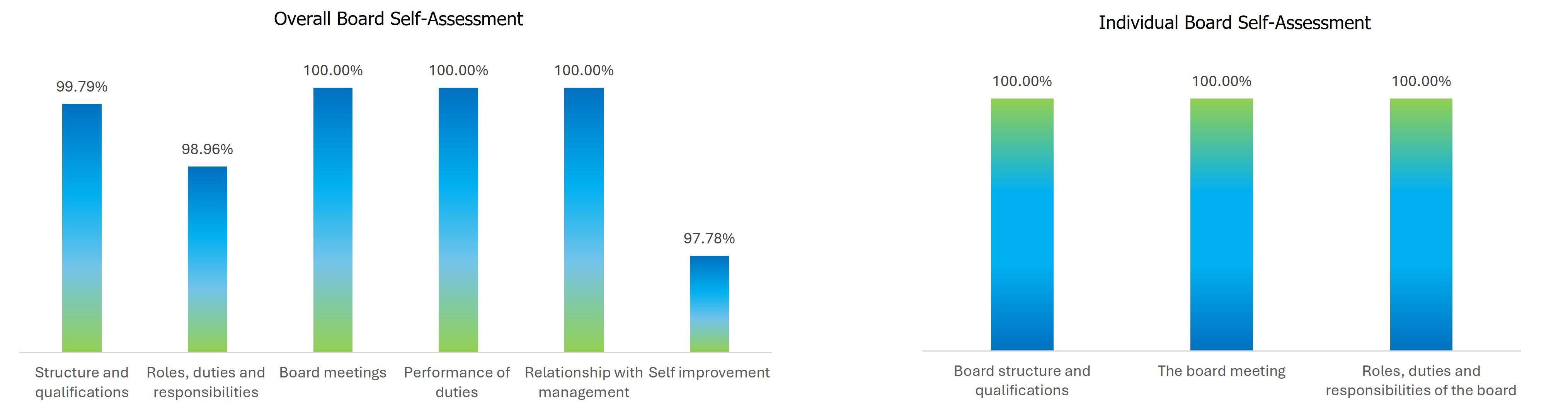
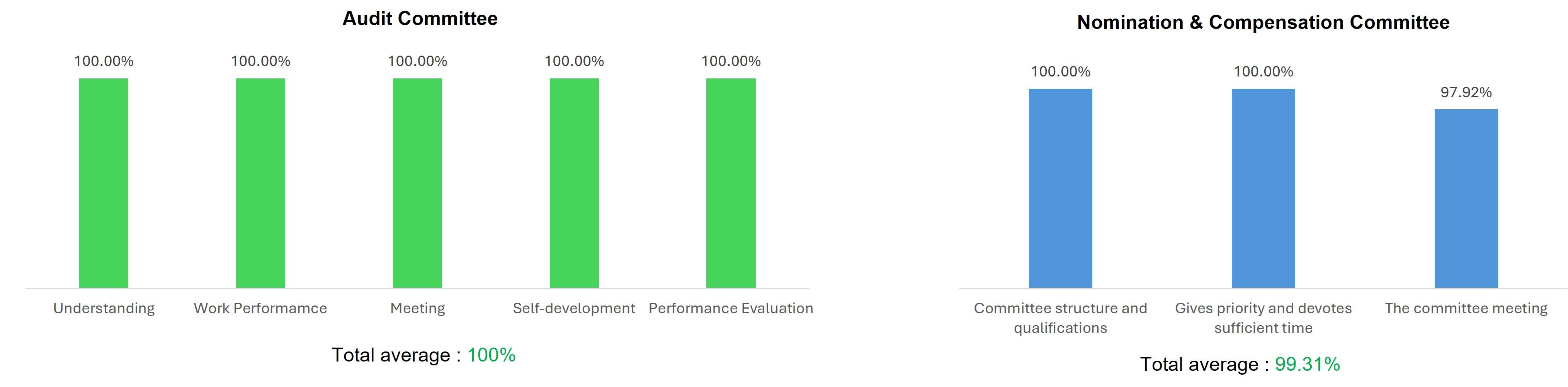
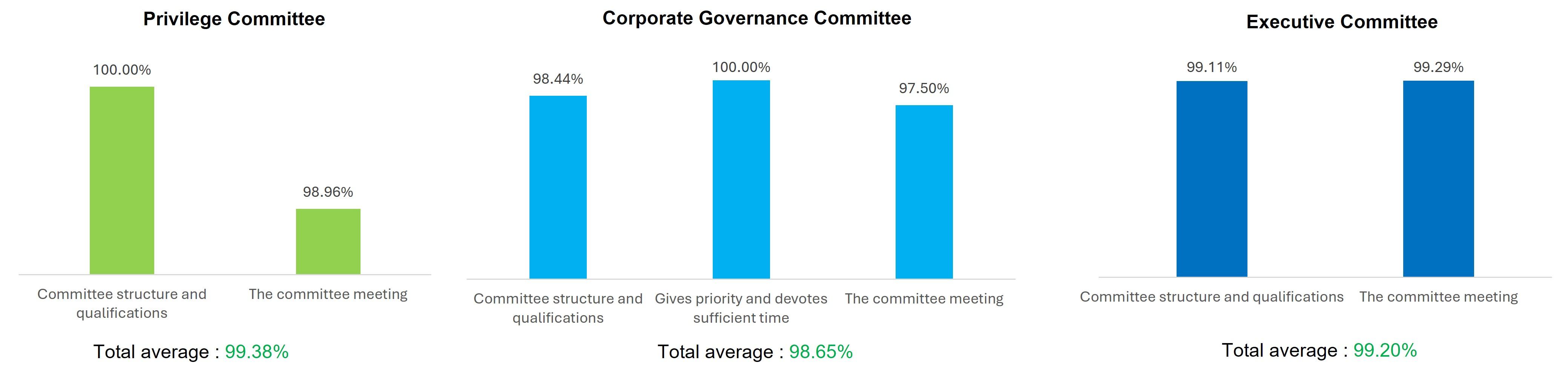
The Board generally arranges assessment forms once a year, namely, Assessment of the Board, Assessment of Individual Directors (self-assessment), Executive Committee’s self-assessment, Audit Committee’s self-assessment, Nomination and Compensation Committee’s self-assessment, Corporate Governance Committee’s self-assessment and Privilege Committee’s self-assessment. Upon completion of the mentioned assessments, the Evaluation Forms will be submitted to the Company Secretary team for tabulation and the results will be presented to the Board together with agreed action plans to address the gaps and improve work efficiency.
Evaluation of Board Performance in the Past Year
Board of Director Self-Assessment consists of 6 items
The results indicated excellent/ most suitable overall performance, with an average score of 99.48%.
Individual Board Self-Assessment consists of 3 items
The results indicated excellent/ most suitable overall performance, with an average score of 100.00%.
Sub-Committee Self-Assessment
Performance Assessment of the CEO
The Board assigns the Nomination and Compensation Committee to determine and propose Key Performance Indicators (KPI) of the President. The evaluation criteria is divided into 4 parts: 1. Corporate Governance Indicators (CG) 2. Operation Annual Strategic Focus Areas Indicators 3. Social & Environmental Indicators 4. Nomination and Compensation Committee Score. The KPIs must be approved by the Board and be reviewed annually. In 2025, the CEO's performance evaluation results were 88.47 percent, which falls within the "Good" criteria.
Subcommittees
Subcommittees
| Results of the Subcommittee's Duty Performance |
|---|
During 2025, the Committee convened 4 meetings and all committee members attended all four meetings to consider important matters and reported the outcomes of these meetings, including comments and recommendations, to the Board of Directors for consideration. The key duties performed are summarized as follows:
|
In 2025, the Corporate Governance Committee held two meetings, with full attendance by all committee members. The meetings focused on key initiatives aimed at strengthening the Company’s ethical standards and governance practices. Significant matters considered during the year included the following:
|
In 2025, the Committee held two regular meetings and convened one special meeting in response to geohazard events in Thailand. During the year, the Committee carried out the following key responsibilities:
|
The Privilege Committee is committed to corporate governance, supporting procedures for receiving privileges from the Thai government, state-owned enterprises, and other related entities to ensure that the Company's privilege procedures and systems contribute to the Company’s long-term success. The Privilege Committee held four meetings in 2025 for the following major tasks:
|
Meeting Attendance & Remuneration
Meeting Attendance — Sub-section Introduction
The company schedules the Board meeting at least four times a year or on a quarterly basis (middle of February and the end of April, July and October). The meeting dates are set in advance throughout the year and informed the Board of Directors of the meeting schedule since the end of last year. Each director must attend at least 75% of the meetings throughout the year. An extraordinary meeting may be arranged when there is an issue to consider. Regular meeting dates will be set in advance for the entire year at least seven days prior to the meeting date (not less than five days). The company will send out invitation letters with the agenda to all directors. In case of emergency, the invitation letters may be sent less than seven days prior to the meeting. Each director is free to propose items for the agenda. The company secretary has the duty to arrange the meetings, take care of and give suggestions to ensure that the meeting is in compliance with all relevant laws and regulations. Minutes of the meeting will be put in writing and those endorsed by the Board will be kept as evidence at the company's office.
The Quorum for Voting
The Board of Directors considered additional policy concerning the quorum for voting at the Board of Director’s meeting by requiring the quorum be not less than two-thirds of the total number of directors. However, the meeting quorum is still required to comply with the company’s Articles of Association that state that at the meeting of the Board of Directors there shall be not less than one half of the total number of directors attending in order to constitute a quorum.
Important Agenda
In 2025, the Board of Directors held a total of seven meetings, during which matters related to sustainability were considered as follows:
BoD no. | Date | Acknowledgement / Approval |
No. 1/2025 | 14-Feb-25 | Report year 2024 operation results of the company and its subsidiaries |
Report of the Risk Management focus and improvement | ||
Report of the Corporate Governance focus on business integrity management improvement | ||
Report on sustainability goals, indicators, and achievements | ||
Report performance of CEO KPIs | ||
Report the board self-assessment results | ||
Report on the appointment of a new executive | ||
Report the progress of operation improvement projects | ||
Report the progress of operation expansion of the Company and its subsidiary | ||
Report on restructuring of subcommittees | ||
No. 2/2025 | 21-Mar-25 | Report the progress of operation expansion of the subsidiary |
No. 3/2025 | 2-Apr-25 | Report the progress of operation expansion of the Company |
Report on intercompany loans between subsidiaries and affiliated companies | ||
No. 4/2025 | 25-Apr-25 | Report Q1-2024 operation results of the company and its subsidiaries |
Report on closure of subsidiaries | ||
Report the progress of operation improvement projects | ||
No. 5/2025 | 25-Jul-25 | Report Q2-2024 operation results of the company and its subsidiaries |
Report on closure of subsidiaries | ||
Report the progress of operation improvement projects | ||
Report the capital change in the subsidiaries | ||
Report on the Company’s 5-year strategic plan | ||
No. 6/2025 | 24-Oct-25 | Report Q3-2024 operation results of the company and its subsidiaries |
Report the progress of operation improvement projects | ||
Report the amendment of key operating policy for strengthening governance and operation efficiency | ||
No. 7/2025 | 28-Nov-25 | Report on acquisition of shares in an affiliated company by a subsidiary |
Report the progress of operation improvement projects | ||
Report the progress of operation expansion of the Company |
Types of Remuneration of the Board of Directors
Compensations of Directors in 2025 are listed as follows;
1. Compensation
The Annual General Meeting of Shareholders approved the compensation of the directors for the year 2025 with details shown below;
1. The Compensation of the Directors
Position Year 2025 Year 2024
Chairman of the Board 2,475,000 2,475,000
Independent Director/ Non-Executive Director 1,495,000 1,495,000
Executive Director 650,000 650,000
Chairman of the Audit Committee 1,750,000 1,750,000
Chairman of the Nomination & Compensation Committee 1,750,000 1,750,000
2. The Meeting Fees
Position Meeting fee/ Meeting
Board of Director Year 2025 Year 2024
Chairman of the Board 25,000 10,000
Independent director/ Non-Executive Director 20,000 10,000
Executive Director - -
Sub-Committee
Chairman 22,000 10,000
Member 20,000 10,000
3. Annual Bonus
The 2025 annual bonus should be paid to the Chairman of the Board and the directors at rates of 60% and 40%, respectively, of the annual compensation for directors under item 1 above.
Remarks
1. Meeting attendance fee are for Chairman of the Board, Non-Executive Director and Independent Director for
their participation in every committee meeting and Shareholders’ meeting.
2. Others compensation of directors: None of other compensation and benefit.
2. ther Compensation None –
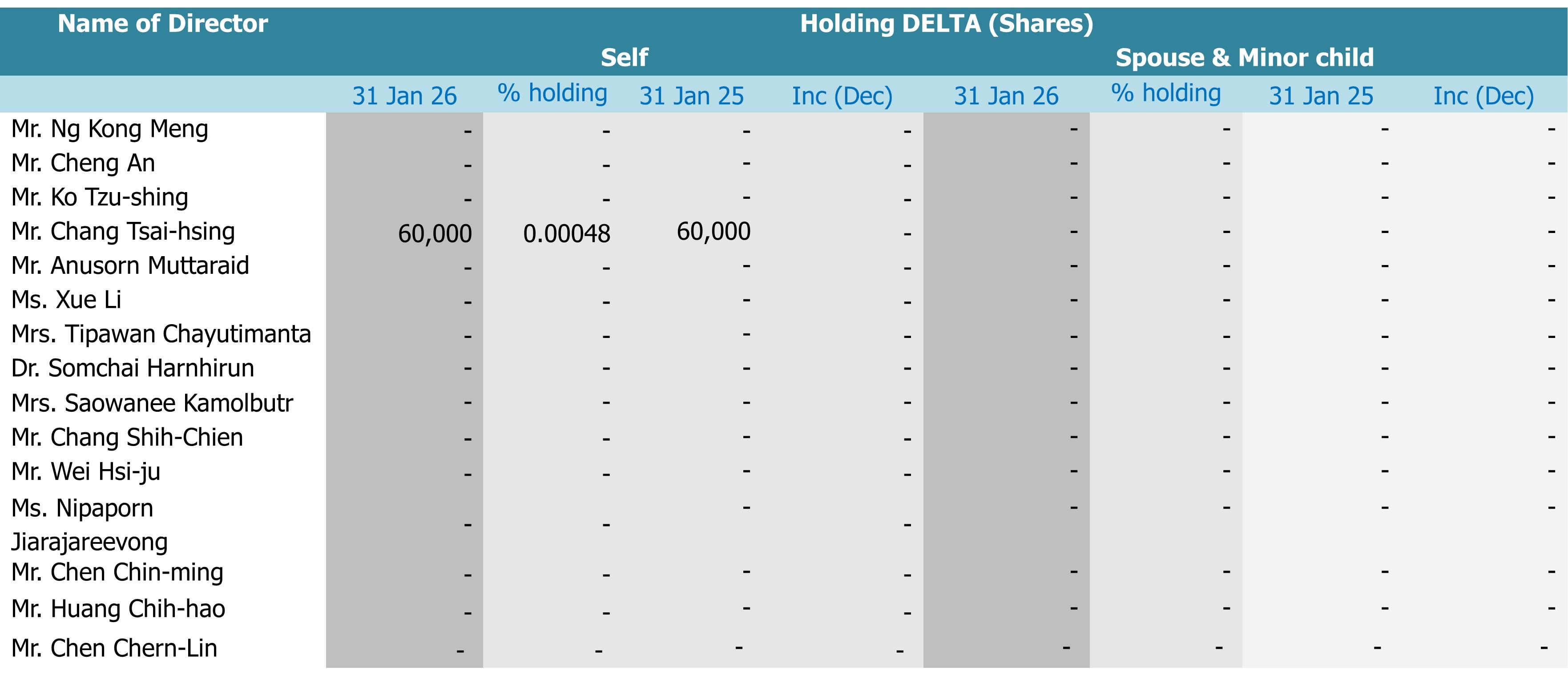
Share/Warrant holdings of Directors and Management
Remuneration or Benefits Payable to the Board
| Metric | Amount (Baht) |
|---|---|
| Remunerations or benefits pending payment to the board of directors over the past year (baht) | 0 |
Supervision of Subsidiaries & Associated Companies
Does the Company Have Subsidiaries or Associated Companies?
Yes
Is There a Mechanism for Overseeing Subsidiaries and Associated Companies?
Yes
Mechanism for Overseeing Management of Subsidiaries
Supervision of Subsidiary and Associated companies
The Board of Directors has assigned the Executive Committee to supervise the operations of subsidiary and associated companies. The Executive Committee has a certain authority to make investments in subsidiaries and associates and may assign some directors or top executives of the companies and/or appoint some local personnel to participate in the Board of Directors or management of its subsidiaries or associates to support management and determine business policies and direction. After appointment, the Executive Committee will report such appointment to the Board of Directors for their acknowledgment. However, if the investment amount exceeds the granted authority, the Executive Committee is required to seek for Board’s approval.
Further supervision and monitoring to ensure compliance with policies are done through the implementation of Enterprise resource planning (ERP) solutions, which effectively gathers and provides important information including finance, accounting and other data, to support the management, controlling and monitoring of subsidiaries and associate’s operations. Furthermore, the Treasury and Investment Section of the company also actively participates in monitoring and supporting the sourcing of funds, capital increase and reduction. It seeks approval from the Executive Committee or Board of Directors for these transactions. Almost all of the companies in the Delta Group are wholly owned subsidiaries so there would be no connected transactions occurring. In the case that there might be some transactions with other related companies in Delta Group, the subsidiaries have been instructed that prior approval from the company’s Executive Committee or Board of Directors is required and relevant SET or SEC’s requirements must also be complied with.
Oversight Mechanisms
| Mechanism |
|---|
| Sending representatives to act as directors, executives or controlling persons in proportion to shareholdings |
| Transactions between the Company and related persons |
| Acquisition or disposal of assets |
| Disclosure of financial information and operating results |
| Other important transactions |
| Internal control system of the subsidiary operating the core business is appropriate and sufficient in the subsidiary operating the core business |
Board Duty Performance — Overview
Board Duty Performance — Overall Description
In 2025, the Board of Directors considered the following key matters:
1. Considered the Company’s goal and operating strategy for 5 years.
2. Considered and approved the construction of a new factory in Bangpoo Industrial Estate and the procurement of
machinery to support future business expansion and enhance competitiveness.
3. Considered amendments to the Anti-Corruption Policy to align with the current situation.
4. Considered sustainability goals, indicators, and achievements.
5. Considered key risk management and improvement.
6. Considered the corporate governance focuses on business integrity management improvement.
7. Considered recommendations of the Audit Committee to ensure the adequacy of the internal control system.
Audit Committee Duty Performance
Results of the Audit Committee's Duty Performance in the Past Year
The Audit committee performed its work during the year according to the Audit Committee Charter, which complies with the guidelines of the Stock Exchange of Thailand. The Audit Committee also fulfilled the matters assigned by the Board of Directors which can be summarized as follows:
Reviewed the quarterly and year-end financial statements independently with the external auditors to ensure that the financial statements and the disclosures were accurate, appropriate, and reliable, and then submitted them to the Board of Directors. The Audit Committeealso received reports from the external auditor that there was no any irregularity that should be investigated.
Reviewed and evaluated the company internal control whether it is adequate and appropriate. Including the effectiveness of the company's internal control system using guidelines from the Office of the Securities and Exchange Commission and COSO-Internal Control Integrated Framework. The committee has not been reported that the company internal control has any significant deficiency.
Reviewed the risks and the risks management f the company so that all the risks were properly managed.
Reviewed and approved the annual internal audit plan, acknowledged the internal audit reports conducted on various key business processes every quarter, along with the issues and provided recommendations to the management, also evaluated the performance of the Internal Audit Manager as well.
Acknowledgedand provided comment/ suggestion the quarterly performance reports to Board of Directors.
Reviewed the related partytransactions or the conflict of interest transactions together with the external auditors that these transactions were reasonable, proper and fully disclosed, including reviewing the internal control of these transactions.
The Committee conducted a self-assessment to review and evaluate its performance by benchmarking it against the Audit Committee Charter and best practice guidelines. The review concluded that the Committee had been effective in carrying out its duties and had followed the terms of reference in the charter.
The committee have considered/reviewed the paper of corruption investigation to be submitted Private Sector Collective Action against Corruption (CAC).
Considered the proficiency and the independence of the external auditor and propose to the Board of Directors including the audit fee in order to propose for approval in the Annual General Shareholder Meeting. The Audit Committee proposed to reappoint EY Office Limited as the Company’s auditor for the accounting period ended December 31st, 2025 by Mr. Chatchai Kasemsrithanawat C.P.A. Registration No. 5813 or Ms. Sutthirak Fakon C.P.A. Registration No. 7712 or Ms. Krongkaew Limkittikul C.P.A. Registration No. 5874, from EY Office Limited with the audit fee for the company's group of THB 6,870,000 (The audit fee for separated of financial statement of the company amount THB 5,410,000) plus the review of subsidiariesfee amount THB 1,460,000.
In summary, the Audit Committee performed its duties as specified in the charter with high caliber, prudence and adequate independence. In the opinion of the committee, Delta’s financial reports were accurately prepared in all material aspects under generally accepted accounting principles. Delta commanded adequate risk management practices, appropriate internal control and internal audit systems, compliance with good corporate governance, legislation, requirements, and obligations relevant to its businesses.
Executive Committee Duty Performance
Results of the Executive Committee's Duty Performance in the Past Year
In 2025, the Executive Committee considered and approved the following matters:
The appointment of directors in subsidiary.
The approval of changes to authorized signatories for banking transactions of the company and its subsidiaries.
The approval of the opening of bank accounts for subsidiary.
The approval of actions relating to the Company’s newly acquired land title deeds.
The approval of increase capital in joint venture company.