

Sustainability · 2025
In this section51 topics
- Sustainability Policy3 items
- Sustainability Goals & UN SDGs3 items
- Policy Review2 items
- Business Value Chain1 item
- Stakeholder Analysis1 item
- Environmental Policy & Guidelines4 items
- Environmental Policy Review1 item
- Energy — Plan & Guidelines4 items
- Energy — Electricity Consumption1 item
- Energy — Fuel Consumption1 item
- Energy — Targets2 items
- Energy — Performance & Outcomes2 items
- Water — Plan & Guidelines4 items
- Water — Withdrawal, Discharge & Consumption1 item
- Water — Targets2 items
- Water — Performance & Outcomes2 items
- Waste — Plan & Guidelines4 items
- Waste — Generation, Disposal & Recycling1 item
- Waste — Targets2 items
- Waste — Performance & Outcomes2 items
- GHG — Plan & Guidelines4 items
- GHG — Emissions1 item
- GHG — Emissions Verification4 items
- GHG — Principles & Standards1 item
- GHG — Targets1 item
- GHG Targets — Net Zero1 item
- GHG Targets — Carbon Neutrality1 item
- GHG — Performance & Outcomes2 items
- Environmental Legal Incidents1 item
- Other Environmental Management1 item
- Social Policy & Guidelines5 items
- Social Policy Review3 items
- Social — Principles & Standards Practised1 item
- Human Rights Due Diligence1 item
- Employees — Plan & Guidelines3 items
- Employees — Workforce3 items
- Employees — Remuneration & Provident Fund1 item
- Employees — Training & Development1 item
- Employees — Occupational Health & Safety1 item
- Employees — Labour Relations1 item
- Employees — Employee Representation2 items
- Employees — Targets1 item
- Employees — Performance & Outcomes2 items
- Customers — Plan & Guidelines3 items
- Customers — Satisfaction Results2 items
- Customers — Targets2 items
- Customers — Performance & Outcomes2 items
- Community & Social — Plan & Guidelines4 items
- Community & Social — Targets2 items
- Community & Social — Performance & Outcomes2 items
- Law Violation Incidents1 item
Sustainability Policy
Has a Sustainability Policy
Yes
Policy Description
Delta Thailand have put sustainability at the heart of our operations as guided by Delta Group’s mission statement “To provide innovative, clean and energy-efficient solutions for a better tomorrow.”
Our ever-evolving sustainable strategy and contingency measures for ESG matters enable the company to respond aptly and responsibly to unexpected disruptions. This long-term commitment to sustainability in our mission and strategy allows Delta to always uncompromisingly deliver on our promise of, “Smarter. Greener. Together.” to our stakeholders.
Policy Document Link
https://www.deltathailand.com/en/csr-commitment
Sustainability Goals & UN SDGs
Has Sustainability Goals
Yes
Goals Description
Our Commitment
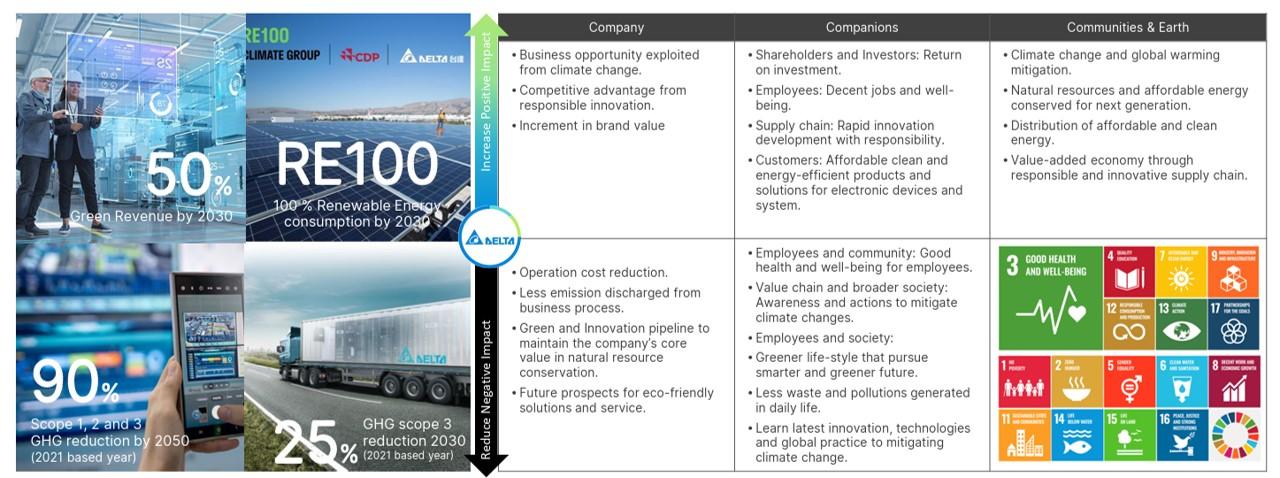
For more information, please visit https://www.deltathailand.com/th/pdf/sustainable/SDR2025_EN.pdf
UN Sustainable Development Goals
| SDG Goal |
|---|
| Goal 3 Good Health and Well-being |
| Goal 4 Quality Education |
| Goal 7 Affordable and Clean Energy |
| Goal 9 Industry, Innovation and Infrastructure |
| Goal 12 Responsible Consumption and Production |
| Goal 13 Climate Action |
| Goal 17 Partnerships for the Goals |
Policy Review
Policy Reviewed This Year
No
Policy Changed This Year
No
Business Value Chain
Value Chain Description
Since 2014 Delta promotes RBA (EICC) Verification Consultation to lower ESG risks in our supply chain and improve competitiveness. Delta Thailand set up a verification and consultation team, “RBA (formerly) EICC committee”, composed of five major departments: Human Resource Administration, Occupational Health and Safety, Facilities, Central Purchasing Control, Purchasing Material Control and Supplier Quality Management. The RBA committee will examine related law and regulation compliance, human rights, labor rights, health and safety, environmental issues and Ethics and Management Systems accordingly to our standard checklist. We found room for improvement for most of our suppliers in Health and Safety aspects of the RBA management system. Delta plan to implement 100% critical supplier RBA audit in 2023.
Stakeholder Analysis
Stakeholder Analysis
| Stakeholder Type | Stakeholders | Stakeholder Expectations | Response to Expectations | Communication Activities |
|---|---|---|---|---|
| External stakeholders | 2923 · Description: Customers | -Sufficient production factors and capacity to meet the growing demand of the technology market.
-Competitive pricing.
-Products and services meet relevant quality standards.
-The manufacturer can provide information on trade-related laws and regulations.
- The manufacturer discloses ESG information in accordance with recognized standards to support outsourcing decisions.
- The manufacturer can provide recommendations for reducing the carbon footprint of products.
- The manufacturer extends its responsibility to the supply chain.Sufficient production factors and capacity to meet the growing demand of the technology market.
- Competitive pricing.
- Products and services meet relevant quality standards.
- The manufacturer can provide information on trade-related laws and regulations.
- The manufacturer discloses ESG information in accordance with recognized standards to support outsourcing decisions.
- The manufacturer can provide recommendations for reducing the carbon footprint of products.
- The manufacturer extends its responsibility to the supply chain.
- Availability of emergency and natural disaster preparedness and recovery plan | - We continuously invest in automation and AI-driven production planning to scale operations efficiently. Our diversified supplier network ensures a stable material supply to meet increasing market demands.
- By optimizing production efficiency, leveraging economies of scale, and using renewable energy, we maintain competitive pricing while ensuring high-quality products.
-Our manufacturing processes adhere to international quality standards such as ISO 9001 and ISO 14001, ensuring that our products consistently meet regulatory and customer requirements.
- Our regulatory compliance team actively monitors global trade laws and provides customers with up-to-date information to facilitate seamless market entry and compliance.
- We publish annual ESG reports aligned with GRI, TCFD, and TNFD standards, ensuring transparency in our sustainability efforts to support responsible business decisions.
- Our R&D team collaborates with customers to develop eco-friendly solutions, including energy-efficient designs, sustainable materials, and lifecycle assessments to minimize carbon footprints.
- We enforce responsible sourcing policies, conduct regular supplier audits, and collaborate with partners to improve ESG performance across the supply chain.We enforce responsible sourcing policies, conduct regular supplier audits, and collaborate with partners to improve ESG performance across the supply chain.
- Our business continuity plan includes risk assessments, backup production facilities, and real-time monitoring to ensure operational resilience in emergencies. | 2938 · Description: Visit · 2941 · Description: Online Communication · 2942 · Description: Internal Meeting · 2943 · Description: External Meeting · 2947 · Description: Satisfaction Survey · 2948 · Description: Training / Seminar |
| External stakeholders | 2911 · Description: Raw material distributors | - Provide continuous long-term purchase orders.
- Communicate ESG targets, requirements, and regulations affecting purchase orders.
- Share technology trends related to materials and components that impact procurement.
- Exchange knowledge and experiences on achieving carbon neutrality.
- Share insights on compliance with new regulations and environmental product disclosures.
- Reward or allocate purchase orders to suppliers that invest in or improve ESG performance.
- Communicate production relocation plans in advance and on a regular basis. | - Communicate the company’s performance as well as its long-term growth targets.
- Clearly communicate ESG goals and compliance requirements with suppliers.
- Provide updates on technological advancements in materials and components that may affect suppliers' procurement strategies.
- Inform suppliers about changes in new regulations and environmental disclosure requirements impacting product sourcing.
- Issue a corporate social responsibility policy for suppliers, which includes measures to increase purchase orders for suppliers with outstanding ESG performance, requiring all suppliers to acknowledge the policy.
- Communicate production relocation plans 6-12 months in advance to allow suppliers to adjust as necessary. | 2938 · Description: Visit · 2939 · Description: Press Release · 2941 · Description: Online Communication · 2943 · Description: External Meeting · 2948 · Description: Training / Seminar |
| Internal stakeholders | 2921 · Description: Employees | - Non-discrimination employment policy
- Training on new regulations and standards frequently inquired about by stakeholders
- Fair compensation and benefits aligned with the cost of living and inflation
- Integration of employees and departments across all business units and regions to achieve both business and ESG goals
- Additional overtime hours and holiday overtime opportunities
- Collaboration with relevant authorities to address traffic congestion in export zones
- Activities or channels to help reduce work-related stress
- Want to be shareholder of the company | - Create an inclusive and fair workplace where all employees are treated equally, regardless of their background or identity.
- Conduct regular training sessions to keep employees updated on changing regulations and stakeholder requirements.
- Continuously review and improve salary structures and benefits in line with economic conditions and the cost of living, in collaboration with union representatives on an annual basis.
- Strengthen collaboration through cross-functional projects and communication platforms to ensure alignment in achieving business and ESG goals.
- Communicate the RBA Business Code of Conduct, which prioritizes labor laws and employee well-being, ensuring all employees acknowledge it and pass the assessment with a 100% score.
- Collaborate with relevant authorities and stakeholders to address traffic congestion. Over the past year, the company has relocated employees to a new factory, opened transportation routes between facilities, and built a parking structure to ease congestion in export zones.
- Implement mental health programs, organize relaxation activities, provide scheduled on-site psychologist consultations at all factories, and support channels for employees to manage work-related stress.
- he company does not have a policy to grant shares to employees and does not organize any activities to encourage investment. However, it does not prohibit retail shareholders. Therefore, the company has issued an announcement on insider trading for all employees at every level to acknowledge. | 2941 · Description: Online Communication · 2942 · Description: Internal Meeting · 2944 · Description: Annual General Meeting (AGM) · 2945 · Description: Complaint Reception · 2946 · Description: Employee Engagement Survey |
| External stakeholders | 2904 · Description: Investors or investment institutions | - Desire to understand the company's long-term goals and growth prospects.
- Seek information on the impact of changing political policies at both national and global levels.
- Want to know how production capacity expansion and various investments, including carbon neutrality initiatives, affect profit, stock price, and dividend rates.
- Concerned about whether the expertise and experience of the management team and C-suite are sufficient to manage various risks.
| Communicate strategic goals, including short-term, medium-term, and long-term objectives, through press releases and relevant activities.
Disclose the impact of changing political policies at both national and global levels, including actual and potential effects, through financial reports, the company’s sustainability report, thematic reports, press releases, and public events.
Publish updates on the implementation of internal carbon pricing mechanisms on the company’s website and in climate-related disclosures alongside financial reports.
Disclose the expertise matrix of board members and C-suite executives on the company’s website. | 2938 · Description: Visit · 2939 · Description: Press Release · 2941 · Description: Online Communication · 2944 · Description: Annual General Meeting (AGM) |
| External stakeholders | 2928 · Description: Society | - Wish to become a Delta employee.
- Want to know about salaries and benefits.
- Seek internship opportunities.
- Request financial support for various projects. | - Disclose available job openings on the company website, Facebook, job recruitment websites, industrial estate job boards, and university job boards at partner institutions.
- Publish the compensation calculation process in the sustainability report. Since salary rates depend on job positions, experience, and other relevant factors, detailed information is only provided to shortlisted candidates.
- Announce available internship positions, the number of interns needed, and the application periods on the company website, Facebook, job recruitment websites, industrial estate job boards, and university job boards at partner institutions.
-Disclose the corporate social responsibility (CSR) policy, types of projects the company supports, and the fiscal year cycle on the company website and in the sustainability report. | 2938 · Description: Visit · 2940 · Description: Social Event · 2941 · Description: Online Communication · 2943 · Description: External Meeting · 2949 · Other name: Collaborative CSR programs · Description: Others |
| External stakeholders | 2907 · Description: Specialists · 2931 · Description: Government agencies and Regulators · 2933 · Description: Non-profit organization / NGOs · 2935 · Description: Independent entities | - Compliance with new law and regulation including emerging social and environmental practices. | - The Risk and Sustainable Development Committee assesses risks in all areas, including legal and regulatory risks. The committee structure includes experts who oversee compliance with relevant laws and regulations within their respective departments.
- Establish training mechanisms and cross-border experience-sharing to enable factories or business units facing new regulations to share their experiences and knowledge within the company group.
- Support organizations in economics and academic institutions at both national and international levels to identify and manage new regulatory risks in advance. | 2940 · Description: Social Event · 2943 · Description: External Meeting · 2948 · Description: Training / Seminar |
Environmental Policy & Guidelines
Has an Environmental Policy
Yes
Policy Description
See: Sustainable Development Report 2025
1) Electric power management:
2) Fuel management:
3) Renewable energy/clean energy management:
Page 82 : Delta is committed to an Energy Conservation & Greenhouse Gas (GHG) Emissions Reduction Policy. This policy is a cornerstone of our sustainable operations, ensuring a better future for our company, employees, stakeholders, and future generations. To achieve this, we apply effective energy and GHG management practices guided by this policy, which aims to:
1) Achieve Renewable Electricity Usage (RE100)
2) Achieve energy reduction 20% within 2030 compared with 2020 baseline
3) Comply with the Energy Conservation promotion Act and ISO 50001
4) Support purchase of energy efficient product and improve energy efficient in process
5) Achieve EV 100 target to minimize GHG emission in transportation and logistics The company has implemented actions to reduce the amount of energy use across its operations in line with this policy
4) Water resource management and water quality:
Page 107 : To maintain the biodiversity in river around the Delta’s site, the water discharge must be tested the environment factor such as TDS, BOD and COD before release drain water to reduce the environmental impacts. To reduce the impact of water stress, Company aims to reduce water withdrawal by 10% within 2030 compared the base year in 2020.
5) Waste management:
Page 103 : To implement sustainable resource use and minimize waste, Delta prioritizes reducing, reusing, and recycling to reduce environmental impact. Our mission also extends to monitoring waste generation trends from our operations and engaging with stakeholder resources. Delta has committed to a target of 100% waste diversion by 2030. Delta committed to all of Delta Thailand's plant sites must verified the UL 2799: Zero Waste to Landfill Program, to improving waste diversion methods and increasing the waste diversion rate.
6) Biodiversity management:
Page 110 : Delta's Board of Directors passed the Delta Group Biodiversity Policy in 2022 to implement avoidance, minimization, restoration, offset and additional actions within the scope of corporate actions. Delta also works with upstream value chain and partners to achieve No Net Loss (NNL) and We aim to achieve the ultimate goal of Net Positive Impact (NPI) by 2050. We will work to identify, assess, manage, and disclose nature-related dependencies, impacts, risks, and opportunities and continue to enhance assessment methodologies to support global biodiversity targets by taking real actions.
7) Greenhouse gas and climate change management:
Page 80 : The company proactively plans and periodically measures its environment-related performances to seek improvement in every process following the Energy Conservation and Greenhouse Gas Reduction Policy. Delta commits to reach net-zero greenhouse gas emissions across the value chain by 2050 from a 2021 base year. Near-term targets is to reduce absolute scope 1 and 2 GHG emissions 90% by 2030 and scope 3 GHG emission 25% within the same timeframe.
8) Air quality management
Page 105 : For Delta’s business operation which emphasized well-being of employee and stakeholders according the Occupational Safety Health and Environmental policy, environmental law, and the scenario IEA SDS in power sector about pollution emissions limits for industrial facilities. The air emission from the process have been monitored the exhaust air quality that release to the environment.
Page 106 : Our company has prioritized the management of Volatile Organic Compound (VOC) emissions. Our long-term target to reduce total VOC intensity by 30% by 2030.
Policy Document Link
https://www.deltathailand.com/en/about-environmental
Environmental Guidelines
| Guideline |
|---|
| Electricity Management |
| Fuel Management |
| Renewable/Clean Energy Management |
| Water Management |
| Waste Management |
| Biodiversity Management |
| Greenhouse Gas and Climate Change Management |
| Air Quality Management |
Environmental Policy Review
Policy Reviewed This Year
No
Energy — Plan & Guidelines
Has an Energy Management Plan
Yes
Plan Description
The company has implemented actions to reduce the amount of energy use across its operations as below
1) Achieve Renewable Electricity Usage (RE100) by 2030
2) Achieve energy reduction 20% within 2030 compared with 2020 baseline
3) Comply with the Energy Conservation promotion Act and ISO 50001
4) Support purchase of energy efficient product and improve energy efficient in process
5) Achieve EV 100 target to minimize GHG emission in transportation and logistics
Plan Document Link
https://www.deltathailand.com/en/pdf/sustainable/SDR2025_EN.pdf
Page Number in Report
82
Energy — Electricity Consumption
Electricity Consumption
| Metric | Current Year | Previous Year | Two Years Ago |
|---|---|---|---|
| Total electricity consumption within the organization (Kilowatt-Hours) | 236,838,200 | 206,605,783 | 163,733,538 |
| Electricity purchased for consumption from non-renewable energy sources (Kilowatt-Hours) | 198,240,400 | 183,886,583 | 145,766,038 |
| Electricity purchased or generated for consumption from renewable energy sources (Kilowatt-Hours) | 38,597,800 | 22,719,200 | 17,967,500 |
Energy — Fuel Consumption
Fuel Consumption
| Metric | Current Year | Previous Year | Two Years Ago |
|---|---|---|---|
| Crude oil (Barrels) | 0 | ||
| Coal (Metric tonnes) | 0 | ||
| Jet fuel (Litres) | |||
| Diesel (Litres) | 300,489.95 | 314,935.16 | 248,378.45 |
| Gasoline (Litres) | 22,353.07 | 55,304.03 | 62,661.11 |
| Fuel oil (Litres) | 0 | ||
| Natural gas (Standard cubic feet) | 5,092,640.85 | 12,608,123.91 | 16,219,288.16 |
| LPG (Kilograms) | 42,828.03 | 20,635.5 | 120 |
| Steam (Metric tonnes) | 0 |
Energy — Targets
Has Set Targets
Yes
Targets
| Target | Base Year | Target Year | Target Change (%) | Unit | Per Unit (Intensity) | Per Unit — Please Specify |
|---|---|---|---|---|---|---|
| Increase of electricity consumption from renewable energy sources | 2,021 | 2,030 | 100 | Megawatt-Hours | Project | Project |
| Reduction of fuel consumption | 2,024 | 2,030 | 100 | Litres | Project | Project |
Energy — Performance & Outcomes
Has Performance Results
Yes
Performance Description
1) Target to achieve 100% Renewable electricity use in operation site by 2030
2025 Target = 60%
2025 Performance = 69%
2) Target to achieve 100% of Corporate Electrical Vehicles (EV) by 2030
2025 Target = 50%
2025 Performance = 76%
Delta Thailand Wins Climate Action Excellence Prize at Climate Action Awards 2025
Water — Plan & Guidelines
Has a Water Management Plan
Yes
Plan Description
1) Recycle Wastewater for Cooling Tower
Delta employs an ICP mechanism to fund employee-driven initiatives aimed at minimize water withdrawal and wastewater. The wastewater treatment system is used to recycle water up to 70 m3/day.
2) Recycle DI Water for process cooling system
A Project installation of DI water treatment from the product cooling process will be treated and recirculate to the process which able to save 5,410 m3/year of fresh water in the DI making process.
3) Recycle Wastewater for Sanitary and garden use
The Sewage Treatment Plants (STPs) is used to treat wastewater in a quality suitable for various non-potable applications such as water closet flushing and gardening. These STP significantly reduce our reliance on fresh water sources.
4) Rooftop rainwater use
The rainwater tanks were to supported the Canteen building and gardening work. The amount of municipal water 2,700 m3/year can be saved from this project. With the simple design concept, this Rooftop rainwater use shall be expanded to other plant for encouraging the water resource conservation to achieve the Delta’s sustainability target.
Plan Document Link
https://www.deltathailand.com/en/pdf/sustainable/SDR2025_EN.pdf
Page Number in Report
108
Water — Withdrawal, Discharge & Consumption
Water Withdrawal, Discharge & Consumption
| Metric | Current Year | Previous Year | Two Years Ago |
|---|---|---|---|
| Total water withdrawal (Cubic meters) | 1,070,670 | 971,100 | 689,780 |
| Total water withdrawal by third-party water (Cubic meters) | 1,044,350 | 917,860 | 667,110 |
| Total water withdrawal by surface water (Cubic meters) | 16,010 | 9,520 | 6,720 |
| Total water withdrawal by groundwater (Cubic meters) | 10,310 | 43,720 | 15,950 |
| Total water withdrawal by seawater (Cubic meters) | |||
| Total water withdrawal by produced water (Cubic meters) | |||
| Percentage of wastewater treated before discharge (%) | 100 | 100 | 100 |
| Total water discharge (Cubic meters) | 454,610 | 376,620 | 136,340 |
| Total water discharge to third-party water (Cubic meters) | 454,610 | 376,620 | 136,340 |
| Total water discharge to surface water (Cubic meters) | |||
| Total water discharge to groundwater (Cubic meters) | |||
| Total water discharge to seawater (Cubic meters) | |||
| Total water consumption (Cubic meters) | 616,060 | 594,480 | 553,440 |
| Recycled water (Cubic meters) | 293,250 | 196,060 | 79,350 |
Water — Targets
Has Set Targets
Yes
Targets
| Target | Base Year | Target Year | Target Change (%) | Unit | Per Unit (Intensity) | Per Unit — Please Specify |
|---|---|---|---|---|---|---|
| Reduction of water consumption | 2,020 | 2,030 | 10 | Cubic meters | Other | Production Ampount (USD) |
Water — Performance & Outcomes
Has Performance Results
Yes
Performance Description
Target to reduce 10% of Plant water productivity intensity (WPI) by 2030 (2020 as based year)
2025 target: 5%
2025 Performace: 10%
Waste — Plan & Guidelines
Has a Waste Management Plan
Yes
Plan Description
1) Investment in innovation to minimize waste :
To encourage investment in waste reduction innovation, Delta employs an ICP mechanism to fund employee-driven initiatives aimed at minimizing waste. In 2024, the Warehouse get an approval for a project to replace stainless steel sheets in place of ESD flooring. this project will be able to reduce waste from ESD flooring by approximately 30 tons annually.
2) Integration of recycling programs to reduce waste to landfill :
Delta India manages its e-waste according to the Pollution Control Act, which mandates that all non-biodegradable waste be handled by authorized recyclers. When a NG product is identified as unusable and classified as ewaste, the designated takes a proactive approach to disassemble the item to separate recyclable components. This process is crucial to divert as much waste as possible from landfills. By adhering to these procedures, Delta India not only complies with environmental regulations but also works to minimize its ecological footprint.
3) Integration of Reuse programs to reduce packaging waste generation :
Packaging from incoming raw materials is a major source of manufacturing waste, and its volume often depends on production schedules. To reduce this waste, Delta has collaborated with our vendors to implement a container reuse program. The carton box and wooden pallet were change to plastic for reuse. We receive only the raw materials, returning the plastic boxes, cardboard boxes, and other plastic packaging to the vendor. This initiative means Delta generates no packaging waste from the raw material input process. These are the significant step that will help us achieve our 100% waste diversion rate target by 2030.
4) Zero Food Waste for a Local Circular Economy :
Our action to reduce food waste to landfills is the one important part of our Sustainable Development work. Since 2020, Delta has collaborated with local community to manage food waste as “Food Cycle model” and promote the “Circular Economy”. In 2024, the food waste 1,899 tons was transferred from our canteens to local farmers to feed animal and make Effective Microorganism (EM). Then the product of local farm will be circulated supply to Delta. Therefore, the food recycle process benefits community and enables us to reduce food waste to landfills which support the target of 100% diversion rate.
5) Waste management training provided to employees :
New hires at Delta are required to complete ESG Training especially waste management as part of their orientation, offered both on-site and online. This ensures they understand foundational requirements before starting work. The training specifically covers waste separation and reduction measures to boost awareness and encourage environmentally friendly practices. Furthermore, since 2021, Delta has enforced a policy mandating that all employees use their own reusable spoons and drinking containers. This initiative aims to reduce plastic waste from the canteen, including single-use spoons, forks, and cups. This policy is clearly communicated to all new employees during their orientation training
Plan Document Link
https://www.deltathailand.com/en/pdf/sustainable/SDR2025_EN.pdf
Page Number in Report
103
Waste — Generation, Disposal & Recycling
Waste Generation, Disposal & Recycling
| Metric | Current Year | Previous Year | Two Years Ago |
|---|---|---|---|
| Total waste generated (Kilograms) | 168,630 | 182,850 | 360,470 |
| Non-hazardous waste (Kilograms) | 156,390 | 163,940 | 343,150 |
| Non-hazardous waste - Landfilling (Kilograms) | 99,880 | 137,530 | 254,600 |
| Non-hazardous waste - Incineration (with energy recovery) (Kilograms) | 56,510 | 26,410 | 88,550 |
| Non-hazardous waste - Incineration (without energy recovery) (Kilograms) | |||
| Non-hazardous waste - Other disposal operations (Kilograms) | |||
| Hazardous waste (Kilograms) | 12,240 | 18,910 | 17,320 |
| Hazardous waste - Landfilling (Kilograms) | 9,530 | 8,250 | 13,300 |
| Hazardous waste - Incineration (with energy recovery) (Kilograms) | 2,710 | 10,660 | 4,020 |
| Hazardous waste - Incineration (without energy recovery) (Kilograms) | |||
| Hazardous waste - Other disposal operations (Kilograms) | |||
| Total reused/recycled waste (Kilograms) | 13,656,030 | 8,787,880 | 8,146,900 |
| Reused/Recycled non-hazardous waste (Kilograms) | 13,656,030 | 8,787,880 | 8,146,900 |
| Reused non-hazardous waste (Kilograms) | |||
| Recycled non-hazardous waste (Kilograms) | 13,656,030 | 8,787,880 | 8,146,900 |
| Reused/Recycled hazardous waste (Kilograms) | |||
| Reused hazardous waste (Kilograms) | |||
| Recycled hazardous waste (Kilograms) |
Waste — Targets
Has Set Targets
Yes
Targets
| Waste Type | Disposal Approach | Target | Base Year | Target Year | Target Change (%) | Unit | Per Unit (Intensity) | Per Unit — Please Specify |
|---|---|---|---|---|---|---|---|---|
| Non-hazardous waste and hazardous waste | 2758 · Description: Reuse · 2759 · Description: Recycle · 2761 · Description: Incineration with energy recovery | Increase waste utilization | 2,021 | 2,030 | 100 | Tonne | Project | Project |
Waste — Performance & Outcomes
Has Performance Results
Yes
Performance Description
Target to achieved 100% Waste diversion rate by 2030
2025 target: 97.50%
2025 Performace: 98.48%
GHG — Plan & Guidelines
Has a GHG Management Plan
Yes
Plan Description
Delta Electronics is committed to achieving net-zero greenhouse gas emissions across our entire value chain by 2050, using a 2021 base year. Near-term targets aim for a 90% reduction in absolute Scope 1 and 2 GHG emissions and a 25% reduction in absolute Scope 3 emissions by 2030, all from the 2021 base. For our long-term targets, we commit to maintaining at least a 90% reduction in Scope 1 and 2 emissions from 2030 through 2050, and to achieving a 90% absolute reduction in Scope 3 emissions by 2050. With our "Smarter, Greener, Together" operation, we enable mutual benefits for Delta, stakeholders, and the world’s environment.
Delta is committed to an Energy Conservation & Greenhouse Gas (GHG) Emissions Reduction Policy. This policy is a cornerstone of our sustainable operations, ensuring a better future for our company, employees, stakeholders, and future generations. To achieve this, we apply effective energy and GHG management practices guided by this policy, which aims to:
1) Achieve Renewable Electricity Usage (RE100)
2) Achieve energy reduction 20% within 2030 compared with 2020 baseline
3) Comply with the Energy Conservation promotion Act and ISO 50001
4) Support purchase of energy efficient product and improve energy efficient in process
5) Achieve EV 100 target to minimize GHG emission in transportation and logistics
The company has implemented actions to reduce the amount of energy use across its operations in line with this policy.
Plan Document Link
https://www.deltathailand.com/en/pdf/sustainable/SDR2025_EN.pdf
Page Number in Report
81
GHG — Emissions
GHG Emissions
| Metric | Current Year | Previous Year | Two Years Ago |
|---|---|---|---|
| Total GHG emissions (Metric tonnes of carbon dioxide equivalent) | 364,026.86 | 193,982.66 | 232,112.07 |
| Total greenhouse gas emissions 1 (Metric tonnes of carbon dioxide equivalent) | 2,722.84 | 2,911.93 | 3,003.77 |
| Total greenhouse gas emissions 2 (Metric tonnes of carbon dioxide equivalent) | 46,354.02 | 49,288.19 | 57,291.05 |
| Total greenhouse gas emissions 3 (Metric tonnes of carbon dioxide equivalent) | 314,950 | 141,782.54 | 171,817.25 |
GHG — Emissions Verification
Emissions Verified by a Third Party
Yes
Verifying Body
2650
Verification Document Link
https://eonemedia.setlink.set.or.th/report/0528/2025/1770167156909.pdf
Verification Web Page
https://www.deltathailand.com/en/pdf/sustainable/SDSM/ISO%2014064-1/2023-ISO14064-1-GHG-Verification-Statement-Official.pdf
GHG — Principles & Standards
Principles & Standards Applied
| Standard |
|---|
| 2671 |
| 2676 |
| 2677 |
GHG — Targets
Has Set GHG Targets
Yes
GHG Targets — Net Zero
Net Zero Targets
| Emission Scope | SBTi Status | Base Year | Base Year Emissions | Near-term Target Year | Near-term Target Change (%) | Long-term Target Year | Long-term Target Change (%) | Target Year | Target Change (%) | Unit |
|---|---|---|---|---|---|---|---|---|---|---|
| 2715 | Approve | 2,021 | 54,763.63 | 2,030 | 90 | 2,050 | 90 | 2,030 | 90 | Metric tonnes of carbon dioxide equivalent |
| 2719 | Approve | 2,021 | 149,858.68 | 2,030 | 25 | 2,050 | 90 | 2,030 | 25 | Metric tonnes of carbon dioxide equivalent |
GHG Targets — Carbon Neutrality
Carbon Neutrality Targets
| Emission Scope | Carbon Neutrality Certified | Certifying Body | Certifying Body — Please Specify | Base Year | Base Year Emissions | Target Year | Target Change (%) | Unit |
|---|---|---|---|---|---|---|---|---|
| 2715 | Y | other | Science-based Targets (SBTi) | 2,021 | 54,763.63 | 2,030 | 90 | Metric tonnes of carbon dioxide equivalent |
GHG — Performance & Outcomes
Has Performance Results
Yes
Performance Description
Delta Thailand Wins Climate Action Excellence Prize at Climate Action Awards 2025
Delta Electronics (Thailand) Public Company Limited has been awarded Climate Action Excellence Prize at the Climate Action Awards 2025, hosted by the Federation of Thai Industries (FTI) during the CCI Climate Change Forum 2025. This marks the first time Delta has received this distinction, recognizing the company’s ongoing progress and leadership on its sustainability journey.
Delta was honored for its strong climate commitments and measurable achievements toward carbon neutrality and net-zero emissions. At the Group level, Delta Electronics, Inc. became the first company in Asia’s technology hardware and equipment sector to achieve validation under the Science Based Targets initiative (SBTi) Net-Zero Standard and one of only 125 companies worldwide to meet this rigorous benchmark. Delta has pledged to reduce Scope 1 and 2 emissions by 90 percent and Scope 3 emissions by 25 percent by 2030, with an overall 90 percent reduction across all scopes by 2050, using 2021 as the baseline.
To deliver on these commitments, Delta Thailand is implementing a broad climate action program. This includes the transition to 100 percent renewable electricity by 2030 under RE100, conversion of its vehicle fleet to zero-emission models under EV100, and the adoption of ultra-low GWP refrigerants across operations. The company is also improving energy efficiency at its facilities, fostering sustainable supply chain practices, and applying an internal carbon pricing mechanism that reinvests revenue into its plants and R&D. Together, these initiatives reflect a comprehensive approach to reducing environmental impact and advancing a low-carbon future.
Environmental Legal Incidents
Legal Violation Incidents
| Metric | Current Year | Previous Year | Two Years Ago |
|---|---|---|---|
| Number of cases or incidents of legal violations or negative environmental impact (cases) | 0 | 0 | 0 |
Other Environmental Management
Plan Description
Refrigerant replacement
Following the guidelines of IPCC 2007 and the ISO 14064 standard, Delta tracks its Ozone Depleting Substances (ODS) within the manufacturing process. In line with the UNEP initiative, which highlights that HCFCs have a lifecycle only about 10% as long as CFC-12, Delta has set a clear target: to replace CFCs with HCFCs in its air conditioning systems to significantly decrease Ozone Depletion Potential (ODP). According to the company's GHG Inventory report, there was no import or export of ODS for Delta's production in 2024. The total ODS emissions for 2024, as verified by a third party based on ISO 14064-1.
Air Emissions monitoring
For Delta’s business operation which emphasized well-being of employee and stakeholders according the Occupational Safety Health and Environmental policy, environmental law, and the scenario IEA SDS in power sector about pollution emissions limits for industrial facilities. The air emission from the process have been monitored the exhaust air quality that release to the environment including
- NOx: Nitrogen Oxides
- SOx: Sulfur Oxides
- CO: Carbon Monoxides
- TSP: Total Suspend Particles
- C8H10: Xylene
- C6H5-CH3: Toluene
- VOCs: Volatile Organic Compounds
- Sn Tin
- Pb: Lead and other
These emission data have reported annually/biannually by third party specialized according to local standard, regulations and U.S. Environmental Protection Agency for each country that Delta operates.
Our Effort to Reduce VOC
Our company has prioritized the management of Volatile Organic Compound (VOC) emissions since 2015. Our primary sources of VOCs in Thailand are volatile organic solvents, including those used as flux removers for printed circuit boards (PCBs) and silicone sealants in our welding processes. In contrast, the VOC emissions at our India site are from diesel engine generator exhaust.
By 2024, the total VOC emissions was 107.35 tons, with an intensity of 0.0265 tons/MUSD. This achievement puts us at 56% of our long-term target to reduce total VOC intensity by 30% by 2030, using 2019 as our baseline. Committed to ongoing improvement, we will be revising our VOC reduction target in 2025.
Social Policy & Guidelines
Introduction
The company is committed to conducting business according to our Corporate Social Responsibility Policy cover to governance, regulator and environment. The policy shall provide guidelines for the directors, management and employees to operate business ethically with transparency, compliance with regulations, accountability and respect for human rights and the fair treatment to all stakeholders. The company shall support promotion and education activities and promote employee participation. This includes building a good relationship with the surrounding communities to promote sustainable quality social and environment.
Has a Social Policy
Yes
Policy Description
Human Rights
Delta Electronics (Thailand) PCL recognizes the importance human rights principles. The Company shall uphold human rights by incorporating internationally recognized human rights related practices, namely The Responsible Business Alliance (RBA)’s Code of Ethics and International Labour Organization’s (ILO) labor standards into the Company’s operations. In addition, the Company’s human rights policy is developed based on the UN’s Guiding Principles on Business and Human Rights – UNGP. We are committed to protecting, respecting and supporting our employees, business partners and vulnerable individuals or groups as outlined in the Company’s human rights policy in all our business processes. We will ensure that human rights are respected and violations of human rights in all forms are prevented throughout the company and our value chain. The company strictly acts on this policy which has been announced on the company’s intranet and website www.deltathailand.com/en/human-rights and the policy is made known to employees by means of training so that all employees adopt a positive attitude towards their co-workers with respect and equitable treatment. There is a mechanism available for feedback and filing complaints concerning human rights issues. To date, no complaint has been filed. For the complete Human Rights Policy, please download at https://deltathailand.com/en/human-rights.
The ongoing war in the Democratic Republic of the Congo which appears to be calming is believed to be majority funded by mining of precious metals including tantalum, gold, zinc, and tungsten. Those rare metals are key raw materials for production of electronic devices. Given their availability in the country with frequent human rights violations such as Congo and Rwanda, these materials from specific countries of origin are consequently known as Conflict Minerals/Metals. The company realizes the importance of human rights and therefore responds to such conflicts by examining the sources of minerals and seeks for procurement from locations outside the conflict areas. The company laid out Conflict Minerals/Metals-free Policy to address prohibits usage of minerals from the Democratic Republic of the Congo and adjoining countries, either directly or indirectly which is defined as an agreement on Responsible Minerals Initiatives (RMI) Agreement (for more details please see www.deltathailand.com/en/related-documents). Implementation of this policy had also been extended to all our supply chains. All our suppliers were required to sign up for acknowledgement on the “Minerals/Metals Source Survey” and “Declaration on Non-use of Conflict Minerals/Metals”. The signing is held as part of the managerial process of our company’s business.
Diversity Equity and Inclusion (DEI)
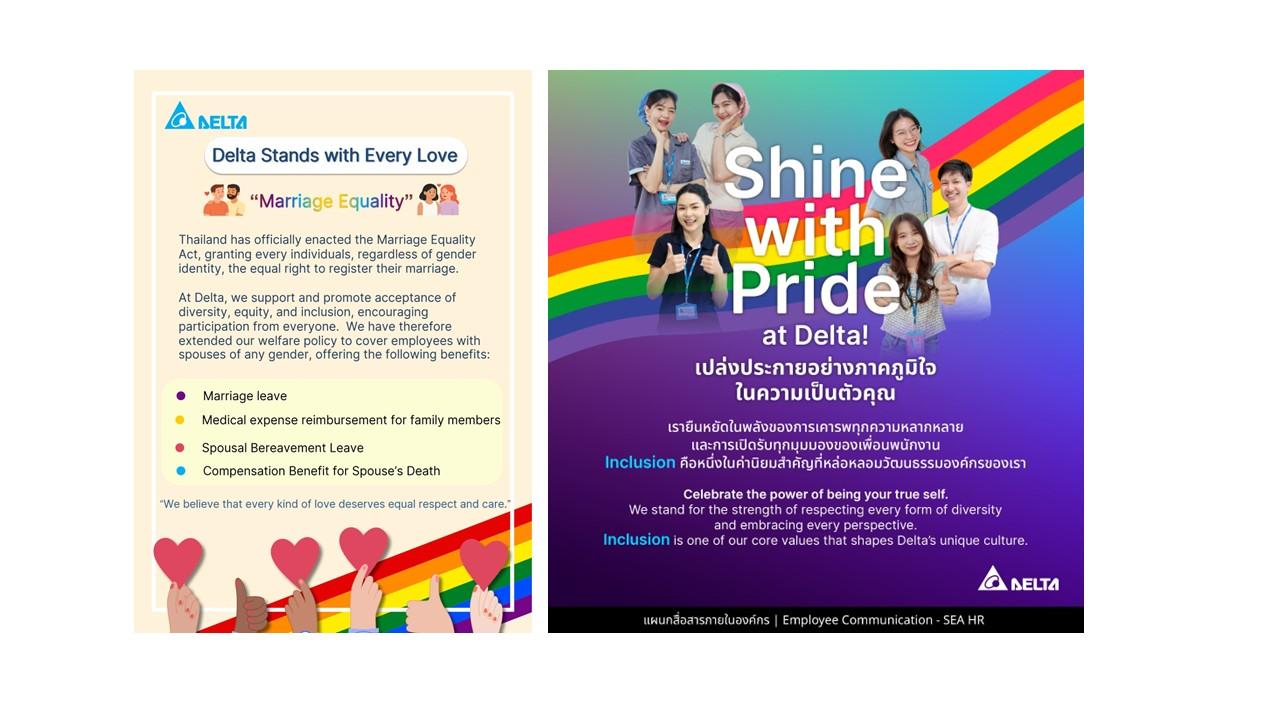
The Delta Group Human Rights and Employment Policy includes our commitment to Diversity Equity and Inclusion (DEI) as one of our fundamental principles. Delta advocates a corporate culture of diversity and inclusion, respect for individual differences, and the integration of diverse viewpoints to strengthen the unique competitiveness of the company. We value the diversity and inclusion in the staffing of people with disabilities, gender diversity, ethnic and racial minorities, and track the implementation status year by year in various management levels and employees, own operational processes and supply chain management. At Delta Thailand, our initiative for Diversity, Equity and Inclusion (DEI) has had a major impact not only in our region but for colleagues around the world. Our new corporate culture has “Inclusion” as we strive to be open to diverse perspectives, respect differing opinions and be inclusive of various backgrounds that offer unique contributions
Policy Document Link
https://deltathailand.com/en/pdf/about/governance/DET-Human-Rights-Policy.pdf
Social Guidelines
| Guideline |
|---|
| Employee Rights |
| Child Labor |
| Consumer Rights |
| Community and Environment Rights |
| Safety and Occupational Health at Work |
| Non-discrimination |
| Business Partner Rights |
Employees — Plan & Guidelines
Has an Employee Management Plan
Yes
Plan Description
Equitable Treatments of Employees
From the policy to treat employees fairly and provide equal career opportunities on the basis of aptitude and capability. Domestic and international trainings are organized regularly to enhance employee skills. The projects and accomplishments in 2025 are as follows:
1. Fair employee compensation
The company places great importance on the remuneration package of its employees to ensure reasonable remuneration based on individual performance and in line with the Company’s operation performance. In addition, the Company also places importance on remuneration by market benchmarking so that remuneration is fair within the organization and competitive with other companies. The company manages remuneration, salary and wages fairly by taking into account factors such as qualifications, experience, job grade, position, responsibility and individual performance; when benchmarking with the salary rate of other companies with a similar business nature; the domestic wage rate, market conditions and demand and the Company’s operation performance. In addition, the Company reviews the remuneration package in collaboration with labor unions every year.
2. Human Development
Languages Courses
In our ongoing commitment to cultivating a diverse and inclusive work environment, DET has the Languages Courses by quarterly. This program aims to empower our employees with language skills that not only boost their professional growth but also contribute to our global collaboration efforts. Employees can indicate their interest in the program, with classes in Chinese, and English conducted by language specialists
Potential Development
The company has the policy to regularly provide a training course for both newcomers and existing employees with a clear written scheme of each training course. To ensure equal opportunity for employee development and provide job-related training to enhance employee capabilities and skill i.e. Six Sigma, Kaizen, and Energy Management System.
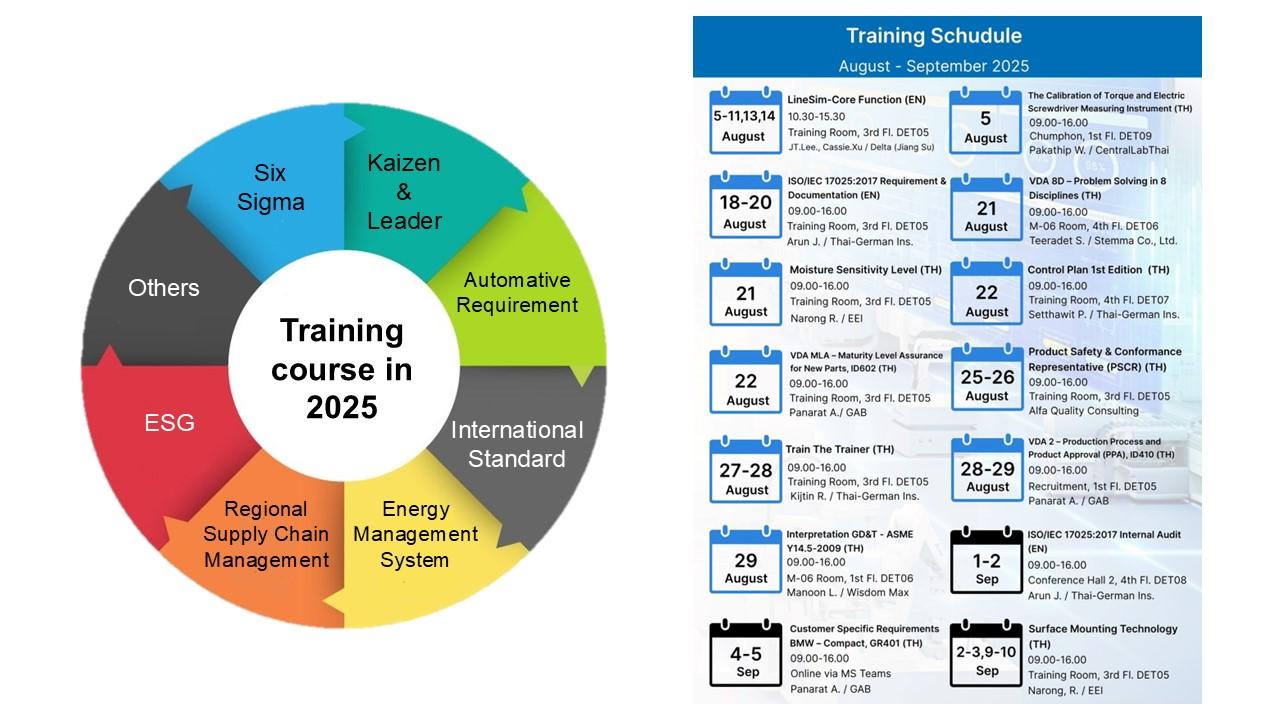
Promoting of Work Potential Development
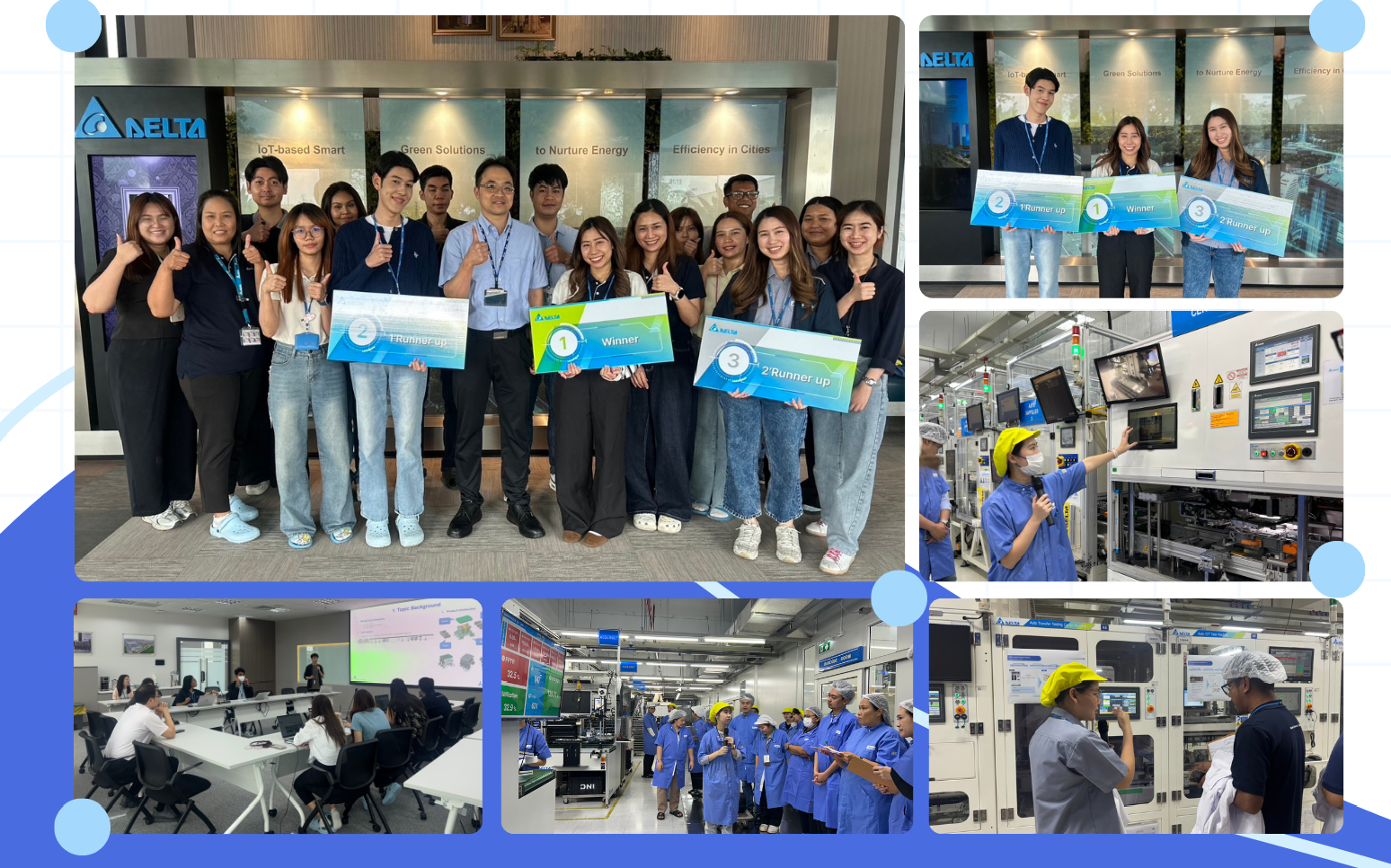
IE Productivity Improvement Award 2025
The "IE Productivity Improvement Award 2025", organized by the IE Training Committee in collaboration with MFG/RD L&D. The program aims to enhance capability development and improve production efficiency across our manufacturing teams through a series of skill-development competitions and on-site Line Tours at both our Bangpoo and Wellgrow plants. This competition aims to promote and strengthen Productivity Improvement through three core evaluation criteria: 1. Line Performance 2. Technology Performance and 3. Productivity Outcome.
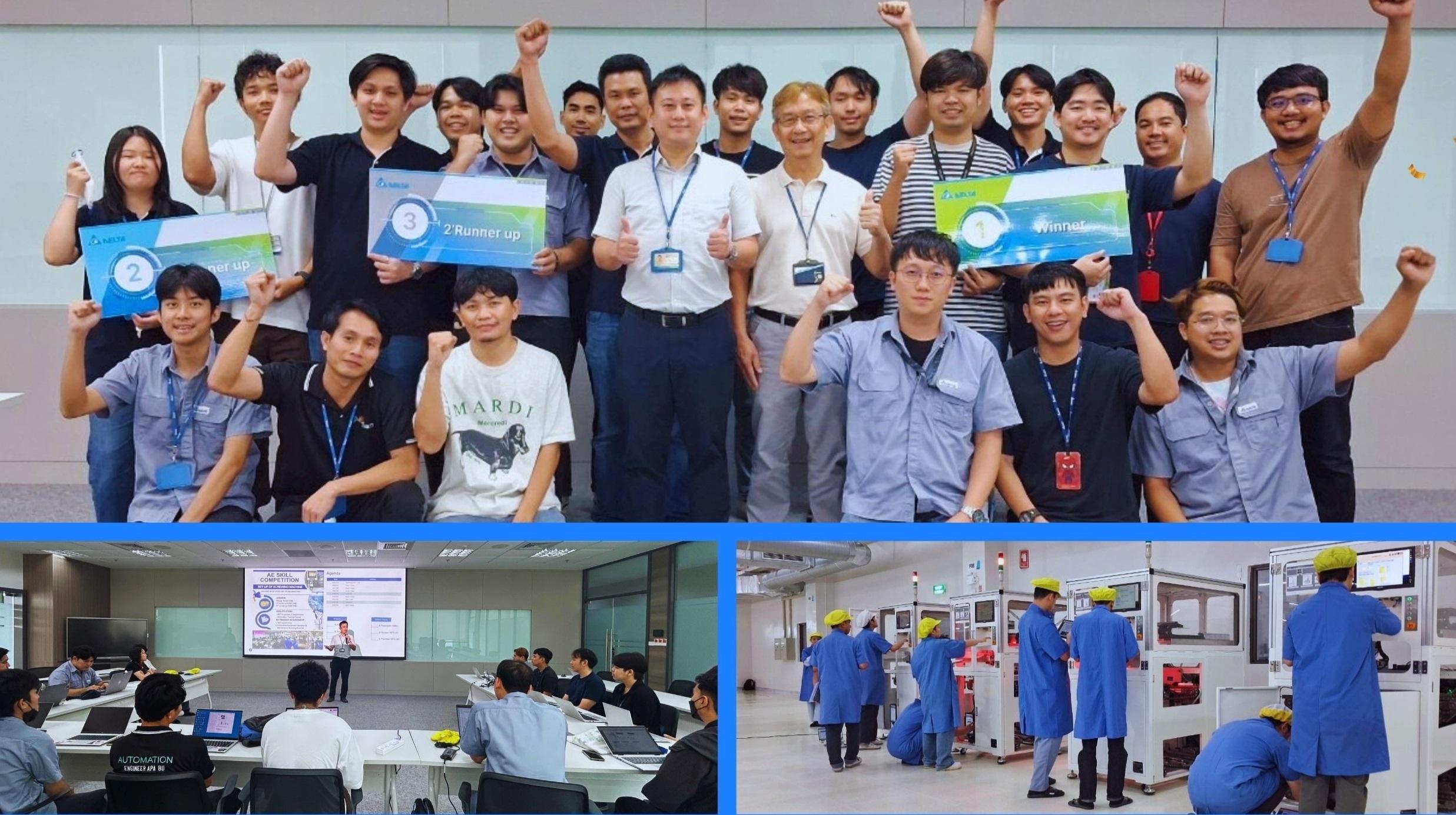
Setup of Screwing Machines Competition
The AE and MFG/RD L&D Training Committee organized the “Setup of Screwing Machines Competition” at DET8 Line One Box. A total of 15 teams from various plants participated in the event. The competition aimed to enhance engineering expertise, identify outstanding talent in resolving machine downtime issues, and provide a platform for employees to showcase their potential, in line with Delta’s commitment to continuous people development.
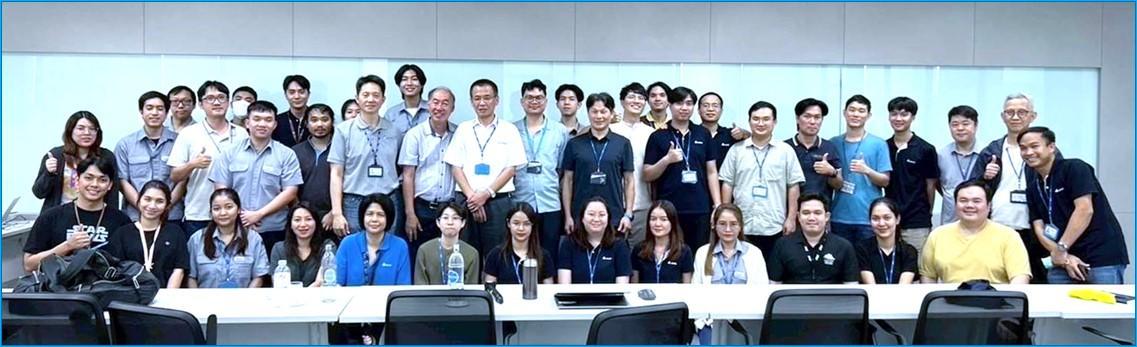
DET KAIZEN On-Site Coaching Activity Summary
The DET KAIZEN On-Site Coaching activity, led by Instructor Prof. Chuah, provided hands-on coaching and direct support for KAIZEN initiatives at the operational site. The session generated valuable insights and enabled the team to identify underlying issues impacting production line efficiency, supporting more effective and sustainable improvements.
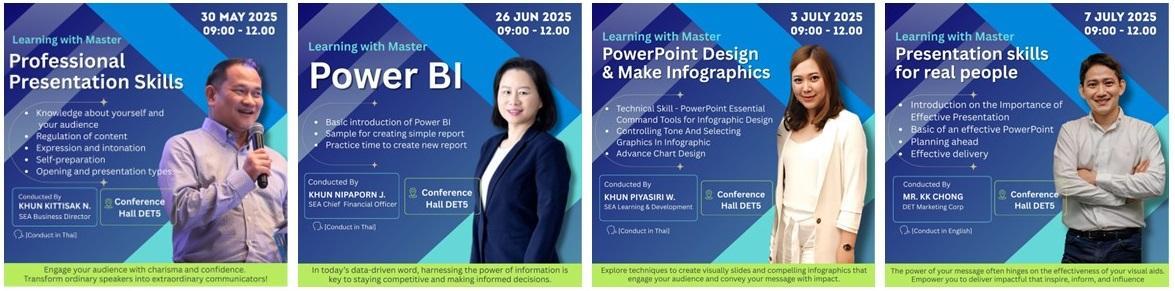
Learning with Master - Core Proficiency Excelsior
"Sharpen your office Skills and build up your own capability" transformative experience is a must for every professional, In this comprehensive training will cover core proficiency skills and this opportunity to hone proficiency skills to employee.
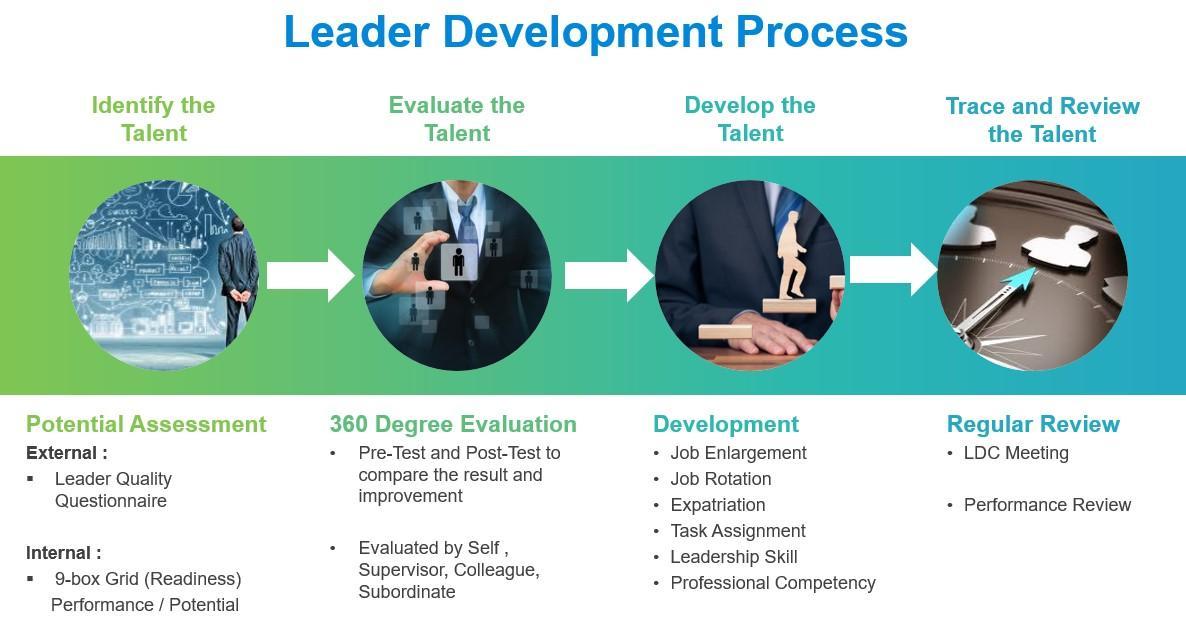
Delta Talent Development
Leader Development Process
Talent is always the most important asset to our company. We believe that professional leaders will be capable of transforming organizations, enacting company values, improving performance efficiencies and engaging their teams to deliver better results. To select the competent and potential talents, we follow the following four steps in identifying talents in our organization. All talents are closely reviewed, monitored and developed with the view to help them grow.
New Manager Foundation Training
Recognizing that strong leadership is the cornerstone of sustainable growth and success, we introduced the New Manager Foundation Training Program this year. This initiative is designed to equip newly promoted and first-time managers with the essential skills, knowledge, and mindset to excel in their leadership roles.
The program focuses on building core competencies such as Delta Core Value & Leader Mindset, People Management, Managing Performance and Employee Feedback, and Interview and Selection Skill. Participants are guided through interactive workshops, real-world case studies to foster confidence and practical expertise.
Delta's Leadership Camp 2025 Mission to MARS
Designed by the HR department, the program focused on developing leadership skills and fostering team collaboration through the MARS concept: Mindset, Accountability, Resilience and Strategy. Participants aligned their 2025 goals and gained valuable cross-departmental insights. In addition, the Best KPI Achievement of Quality and Best KPI Achievement of Customer Satisfaction awards were presented to the management teams of each plant.
3. Promoting employee relations and participation
The company conducted the 2024 Global Engagement Survey to enhance communication, promote company culture, and improve global operational effectiveness, Delta commissions a third party to conduct a global employee engagement survey every two years to better understand the issues and concerns that matter to our colleagues, which will enable the company to effectively improve operations and align with employee expectations. This initiative is part of our ongoing efforts to improve operational results and promote continued growth as a company and making Delta a better workplace. According to the employee satisfaction survey for 2024, it was found that the satisfaction of daily employees increased from 83.2 percent in 2022 to 88 percent for monthly employees. The assessment topics that received the highest increase in satisfaction were 1) Recognition, 2) Trust, and 3) Inclusion.
For areas that received low evaluation scores, the company will conduct quarterly employee engagement surveys to continuously monitor progress. The results from the past year’s survey indicate increased employee satisfaction with employee health and well-being initiatives, as well as greater confidence in the company’s core values.
The company has collected survey results to implement through various projects and committed to listening to employee feedback. In 2025, we have developed and implemented various programs as below:
Employee Healthcare
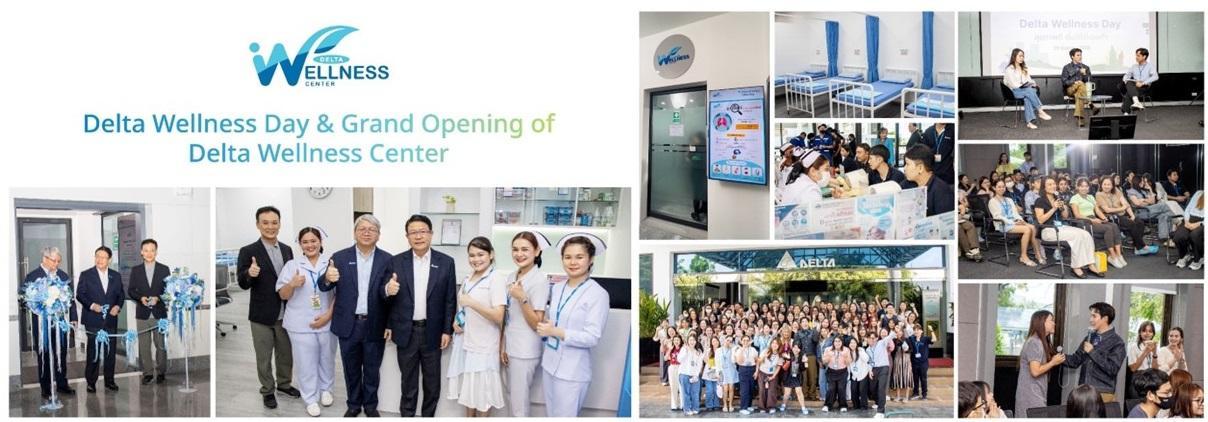
The Company has opened a new Delta Wellness Center to support the growing number of employees. The Center provides services that are certified and registered with the Provincial Public Health Office, offering care from general practitioners as well as specialist physicians, such as ear, nose, and throat (ENT) specialists, in addition to an on-site clinical psychologist. The Center is designed to support employees’ holistic health and well-being, and when employees fall ill, the Company is fully prepared to provide care through this facility.
Health Knowledge
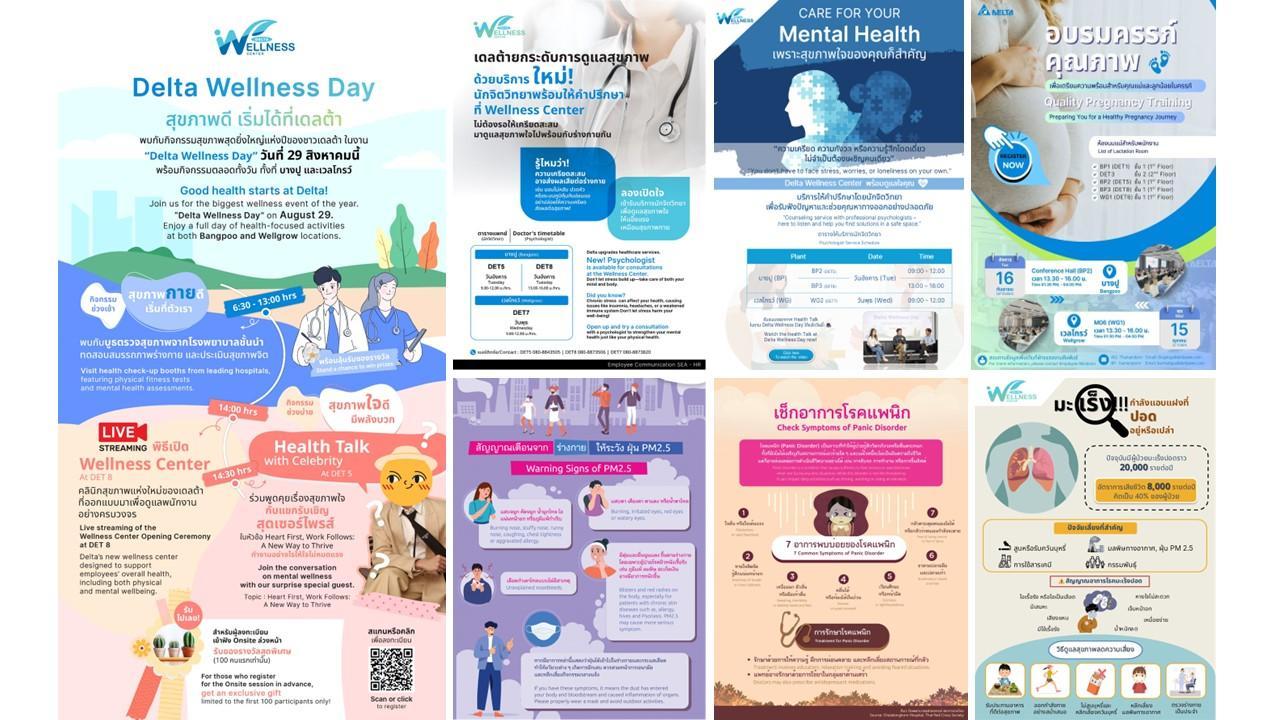
The company has strengthened its employee health and well-being initiatives through training programs delivered by external experts, together with education on physical self-care. These efforts aim to promote good health and resilience among employees. Health education and awareness programs are communicated and conducted on a regular basis to ensure consistent and ongoing engagement.
Employee Recognition and Appreciation
The Company organizes the Most Remarkable Awards program to recognize employees with outstanding performance who deserve acknowledgment. In 2025, our organization is embracing “Collaboration” as the theme of the year, emphasizing the value of working together and harnessing each other’s strengths. Collaboration will be the key criterion in recognizing employees who foster teamwork and help build a truly collaborative culture at Delta.

Enhancing Internal Communication
The Company has established an Internal Communications Department to serve as a central platform for effective communication between employees and the organization. Over the past year, the Company organized a range of initiatives to strengthen internal engagement and collaboration, along with employee satisfaction surveys to evaluate effectiveness and support continuous improvement, as outlined below:
1. Coffee Talk Program
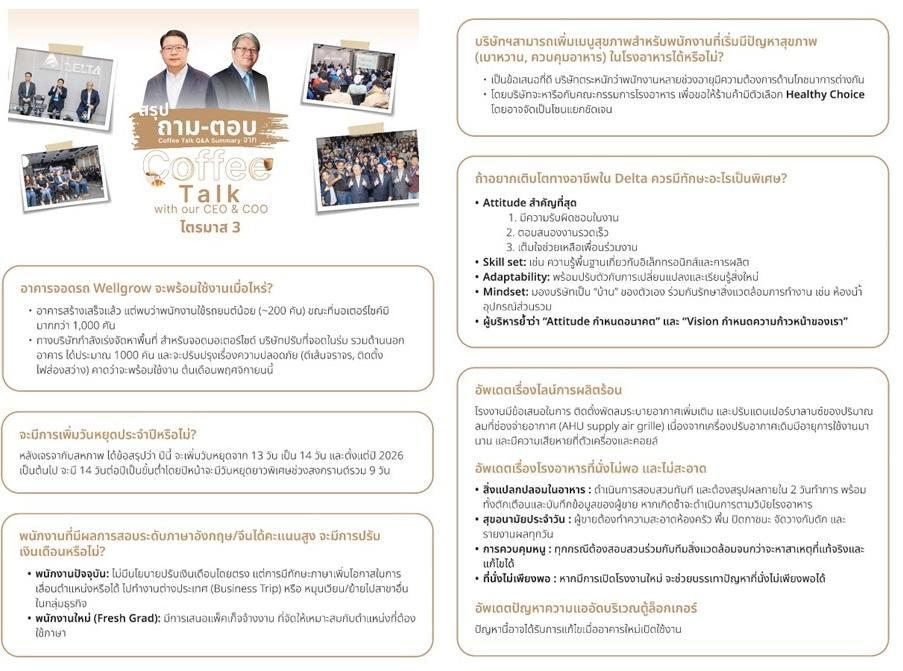
The Company provides employees with opportunities to engage in open dialogue and raise questions directly with the CEO and the President & COO on a quarterly basis. These sessions encourage the exchange of perspectives and the sharing of ideas with senior management. The discussions are also streamed through online channels to enable broader employee participation. A summary of the questions and responses is subsequently distributed to all employees via email.
2. Development of Platforms and Activities to Enhance Employee Communication
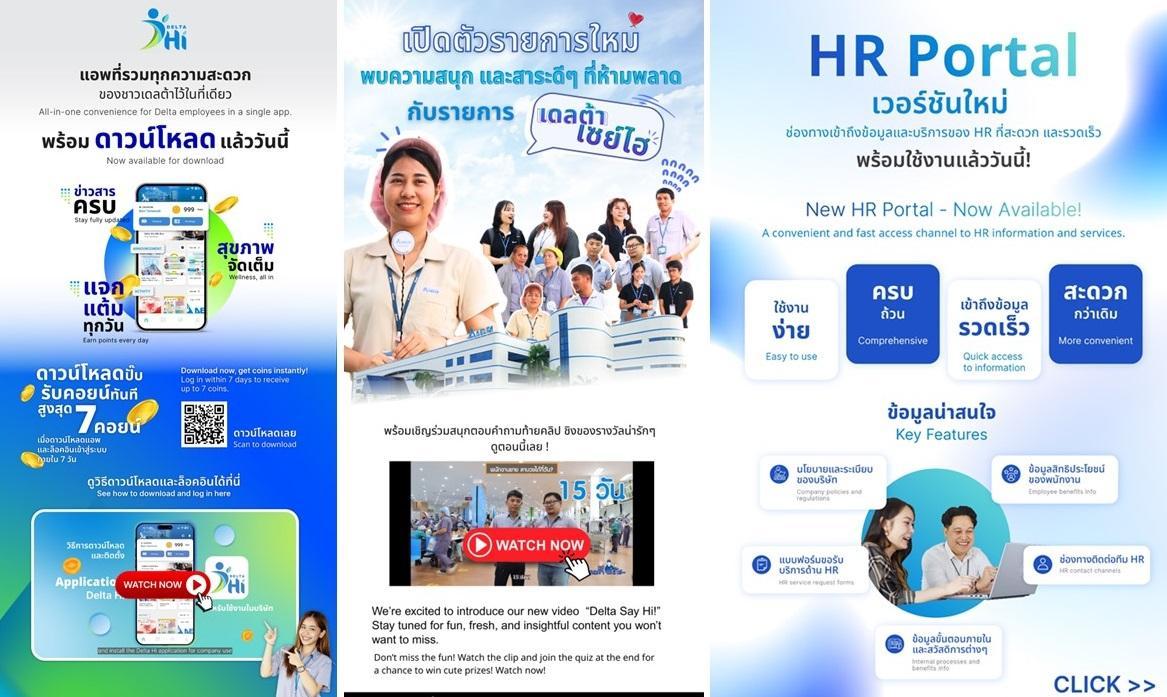
The Company has developed various platforms and initiatives to strengthen communication and engagement with employees, including:
Delta Hi Application : A mobile application that provides employees with company news, health-related information, and updates on corporate activities.
Delta Say Hi! : An interactive activity that encourages employees to participate in a relaxed and engaging way by answering questions related to Company rules and regulations.
Kanom Talk : A casual discussion forum where employees can exchange ideas and receive the latest updates from the Human Resources and Labor Relations teams.
HR Portal : A convenient and efficient channel for employees to access information and services provided by the Human Resources Department.
4. Occupational Health, Safety and Work Environment
Safety, occupational health and work environment are of equal importance among other operational business goals of the company. Management of each division will be responsible for keeping effective implementation of this policy. Every operational unit is to be assessed of impact and its staff is to be consistently trained.
An environmental committee is also established to ensure compliance of occupational health and safety in accordance with the Standards of environmental management system-ISO14001 and Standards of occupational health and safety–OHSAS18001. The company has been certified with these two standards consecutive years.
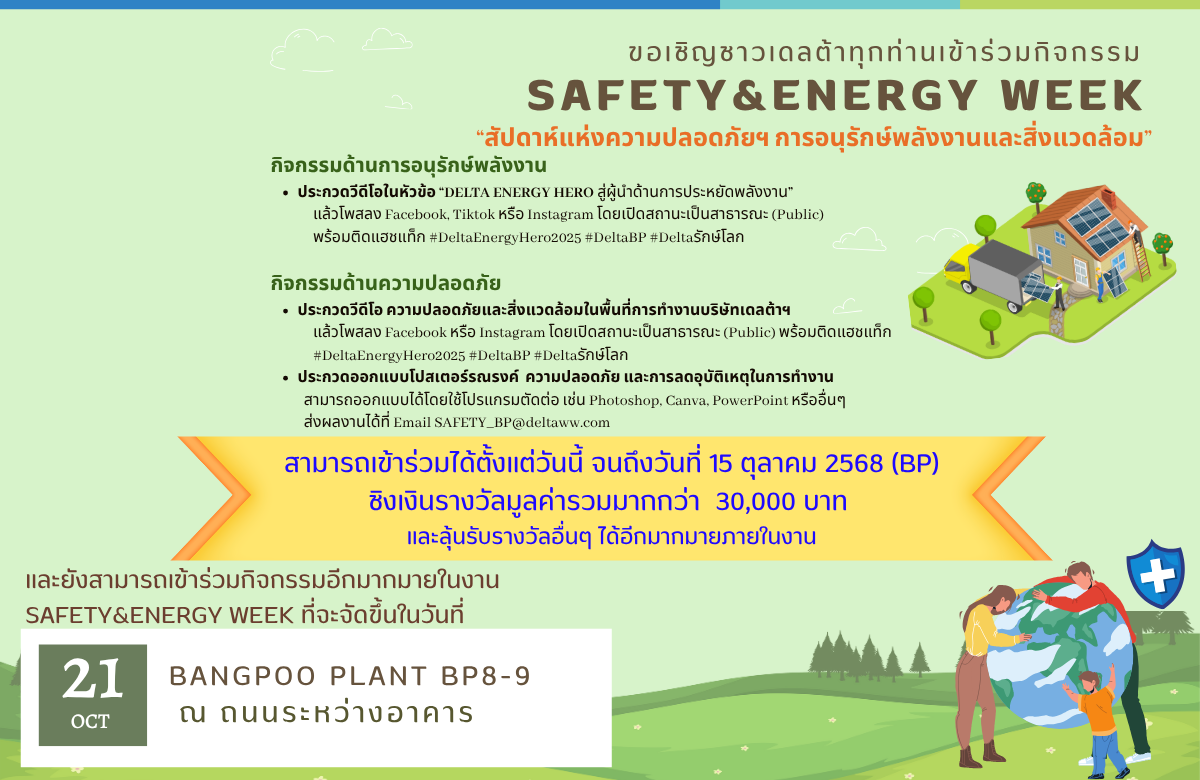
Promoting our Zero Accident campaign in the workplace is one of the key goals that the company aims to achieve and consistently drives performance towards. Although work-related accidents are on a downward trend, our company still actively runs a Safety Week event in a bid to achieve zero accident. This event promotes and educates employee to have safety awareness.
The number of work-related injuries can be found in the Sustainability Report 2025 at the website https://deltathailand.com/en/download-sd-report
In addition, the company regularly organizes "Safety, Energy Conservation and Environmental Week" events to promote safety every year.
Plan Areas
| Plan Area |
|---|
| Fair employee compensation |
| Employee training and development |
| Promoting employee relations and participation |
| Occupational health and safety in workplace |
Employees — Workforce
Workforce — Introduction
In 2025, the company and its subsidiaries had a total number of employees of 32,900 and the total compensation including salary, bonus and provident fund paid to employees was THB 19,419 million. In Thailand, there were 24,865 employees, with THB 12,902 million paid for compensation including salary, bonus and provident fund.
Employees with Disabilities — Introduction
The company recognizes to improve the quality of life of people with disabilities to have the opportunity to earn income for self-reliance and the company has encouraged the implementation accordingly the Persons with Disabilities Empowerment B.E. 2550. In 2025, the company has employed and promoted occupations by granting concessions and organizing a place to distribution of goods 111 disabled workers according to the ratio between normal worker and people with disabilities at 1 disabled worker per 100 normal workers as required by law.
Workforce Data
| Metric | Current Year | Previous Year | Two Years Ago | Remark |
|---|---|---|---|---|
| Total number of employees (Persons) | 21,891 | 19,429 | 21,244 | Unit : FTE 1. Headcount data is the information as at 20 December 2025 2. FTE formular: Worker actual working day / Total working day per 2025 working calendar. 3. The FTE calculation include all type of worker and all workers who join and left the company during the 2025 calendar year. |
| Number of male employees (Persons) | 4,710 | 4,045 | 4,129 | Unit : FTE |
| Number of female employees (Persons) | 17,181 | 15,384 | 17,115 | Unit : FTE |
| Total employment of disabled persons (people) | 18 | 16 | 17 | |
| Total disabled employees (people) | 18 | 16 | 17 | |
| Total male disabled employees (people) | ||||
| Total female disabled employees (people) | ||||
| Total disabled workers who are non-employee (people) | ||||
| Contributions to the fund for promoting and improving the quality of life for disabled persons | 0 | 0 | 0 | |
| Total number of male employees in operational level (Persons) | ||||
| Total number of male employees in management level (Persons) | ||||
| Total number of male employees in executive level (Persons) | ||||
| Total number of female employees in operational level (Persons) | ||||
| Total number of female employees in management level (Persons) | ||||
| Total number of female employees in executive level (Persons) |
Employees — Remuneration & Provident Fund
Remuneration & Provident Fund
| Metric | Current Year | Previous Year | Two Years Ago |
|---|---|---|---|
| Total disabled employees (people) | 12,902,000,000 | 10,187,000,000 | 10,323,000,000 |
| Total male employee remuneration (Baht) | |||
| Total female employee remuneration (Baht) | |||
| Number of employees eligible to participate in PVD (persons) | 11,316 | 10,328 | 10,259 |
| Total number of employees joining employee provident fund (Persons) | 7,935 | 7,541 | 7,943 |
| Percentage of total number of employees joining employee provident fund to total number of employees (%) | 36.25 | 38.81 | 37.39 |
| Number of PVD members / Total eligible employees (%) | 70.12 | 73.02 | 77.42 |
| Total amount of provident fund contributed by the Company (Baht) | 235,346,219 | 205,688,538 | 190,747,754 |
| Total amount of provident fund contributed by employee (baht) |
Employees — Training & Development
Training Data
| Metric | Current Year | Previous Year | Two Years Ago |
|---|---|---|---|
| Average employee training hours (Hours / Person / Year) | 46.6 | 44.8 | 42.3 |
| Employee development and training expenses (baht) |
Employees — Occupational Health & Safety
Occupational Health & Safety Data
| Metric | Current Year | Previous Year | Two Years Ago |
|---|---|---|---|
| Total number of lost time injury incidents by employees (Cases) | 14 | 20 | 58 |
Employees — Labour Relations
Labour Relations Data
| Metric |
|---|
| Total voluntary resignations (Persons) |
| Male employees who voluntary resigned (Persons) |
| Female employees who voluntary resigned (Persons) |
| Percentage of employee turnover leaving the Company voluntarily (%) |
| Evaluation result of employee engagement |
Employees — Employee Representation
Employees Are Represented Collectively
Yes
Forms of Representation
| Form |
|---|
| Labor relations committee |
| Labor union |
Employees — Targets
Has Set Employee Targets
No
Employees — Performance & Outcomes
Has Performance Results
Yes
Performance Description
Awards in Human Resource Management
The Top 55 Most Attractive Companies to Work For in Thailand
Delta Electronics Thailand has been recognized for the first time as one of the Top 55 Most Attractive Companies to Work For in Thailand, according to the QGEN Thailand Most Attractive Companies (QMAC) 2026 ranking. Delta was ranked at 47th among the Top 55 employers nationwide.
Conducted by QGEN Consultant, a Thailand-based people and organization consulting firm, the QMAC survey gathered over 5,000 valid responses from individuals aged 20-40 across Thailand, including university students, fresh graduates, job seekers, and working professionals.
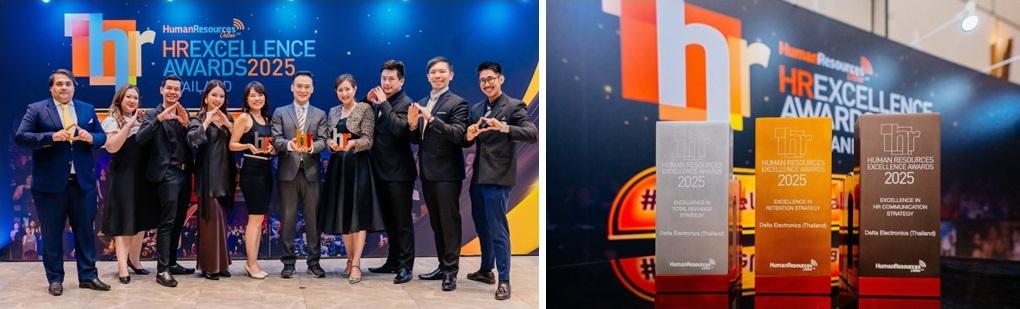
HR Excellence Awards Thailand 2025
Delta Thailand received the HR Excellence Awards Thailand 2025, organized by Human Resources Online, a leading human resources media platform in the Asia region. The Company won a total of three awards, including a Gold for Excellence in HR Retention Strategy, Silver for Excellence in HR Total Rewards Strategy, and Bronze for Excellence in HR Communication Strategy.
Customers — Plan & Guidelines
Has a Customer Management Plan
Yes
Plan Description
The company is committed to its mission of providing products, services and solutions under short to long-term contracts that fulfill customer’s requirements. In addition, the company has a policy to produce quality products in accordance with international standards, fairly, considering impact on health and safety. In order to gain customer’s confidence and satisfaction.
The company has established a Customer Satisfaction Procedure Survey and Customer Feedback Process. The results are improved development and satisfaction for our customers in the long term, including keeping customer information confidential.
Plan Areas
| Plan Area |
|---|
| Responsible production and services for customers |
| Development of customer satisfaction and customer relationship |
| Protection of customer personal information |
Customers — Satisfaction Results
Introduction
The company strives to bring the highest level of satisfaction to its customers by offering high quality products and impressive services. In this connection, the company applies various international standards to its operations to raise consumer confidence and it is certified to a number of internationally-recognized standards as follows;
ISO9001 - International Standard of quality management system
IATF16949 - International Automotive Task Force
TL9000 - International Standard of quality management system for telecommunications Industry
ISO/IEC17025 - Standard of quality laboratory system
IEC-61340-5-1 and ANSI / ESD S20.20 - Standards of Electrostatic Discharge Control Program
Authorised economic operator (AEO) Certificate - European commission declared by The Customs department, Thailand
ISO 13485 - Quality management system for medical device
IECQ QC 080000 - Hazardous Substance Process Management System
The company also concerns about consumer safety and has in place procedures to properly manage environmental-related substances to control and prevent the use of hazardous chemicals in production processes. This effort is to assure consumers that the company’s products contain no toxic substances that are harmful to them.
The company actively communicates with customers of every segment to ensure maximum reach as well as help fulfill their needs. Customers can learn more about information and news of our products from www.deltathailand.com. Feedback can also be emailed to info@deltathailand.com as displayed on the company’s website. Feedback and comments will be presented to the company’s management for analysis and solution findings for further development.
The company conducted Customer Satisfaction survey by using on-line questionnaire to ensure our business really suit our customer’s needs. With 80% satisfaction rate as Delta’s qualitative target, the survey help to reflect the customer satisfaction level on the company’s product, service and business ethics, etc. in different aspect. Meanwhile, feedback from other comment portion, has brought to Sustainable Development Committee, Strategic Marketing, Sales Meeting to seek for further improvement accordingly. In 2024, the company was able to maintain a satisfaction rate of 82.3%, which is satisfactory.
Customer Satisfaction Results
| Metric | Current Year | Previous Year | Two Years Ago |
|---|---|---|---|
| Evaluation results of customer satisfaction | 1 | 1 | 1 |
Customers — Targets
Has Set Customer Targets
Yes
Targets
| Indicator | Target Areas | Base Year | Base Year — Description | Target Year | Target Year — Description |
|---|---|---|---|---|---|
| Customer Satisfaction | 3009 · Description: Development of customer satisfaction and customer relationship | 2,023 | Target 80% | 2,025 | Higher than 80% |
| Number of complaints regarding customer personal data protection | 3010 · Description: Consumer data privacy and protection | 2,023 | No complaints case | 2,025 | No complaints case |
Customers — Performance & Outcomes
Has Performance Results
Yes
Performance Description
Delta Sets Global Benchmark with First 80 PLUS Ruby-Certified 5,500W Server PSU from Thailand
Delta Thailand, proudly announces that its 5,500W high-end redundant server power supplies, manufactured in Thailand, are the first in the world to receive the 80 PLUS Ruby certification. Delta has drawn upon its superior prowess in soft-switching technology and advanced circuit topology to not only surpass the stringent requirements of the 80 PLUS Ruby certification, but also to deliver a 59% increase in power density at 51W/inch3. Delta’s certified PSUs enable customers to enhance energy efficiency, lower carbon emissions, and optimize power usage contributing directly to global sustainability goals.

Community & Social — Plan & Guidelines
Introduction
Delta is committed to performing its business operations in accordance with the corporate social responsibility policy, including fair treatment to stakeholders. The company also supports international standards, such as the International Labor Office Tripartite Declaration of Principles Concerning Multinational Enterprises and Social Policy and the Global Reporting Initiative: GRI.
This is the corporate social responsibility policy to which the company adheres at all times, resulting in Delta being accepted by the nearby communities, including government sectors, schools, and hospitals, for its participation in social activities. Both in terms of support and disseminating innovations to the community to reduce the impact and create good relationships with the community.
The company’s most important goal is the commitment to the employees’ quality of life, including the family within the community where they live. In the year 2025, the company has organized social projects as follows.
Has a Community & Social Plan
Yes
Plan Description
Professional Skill Development
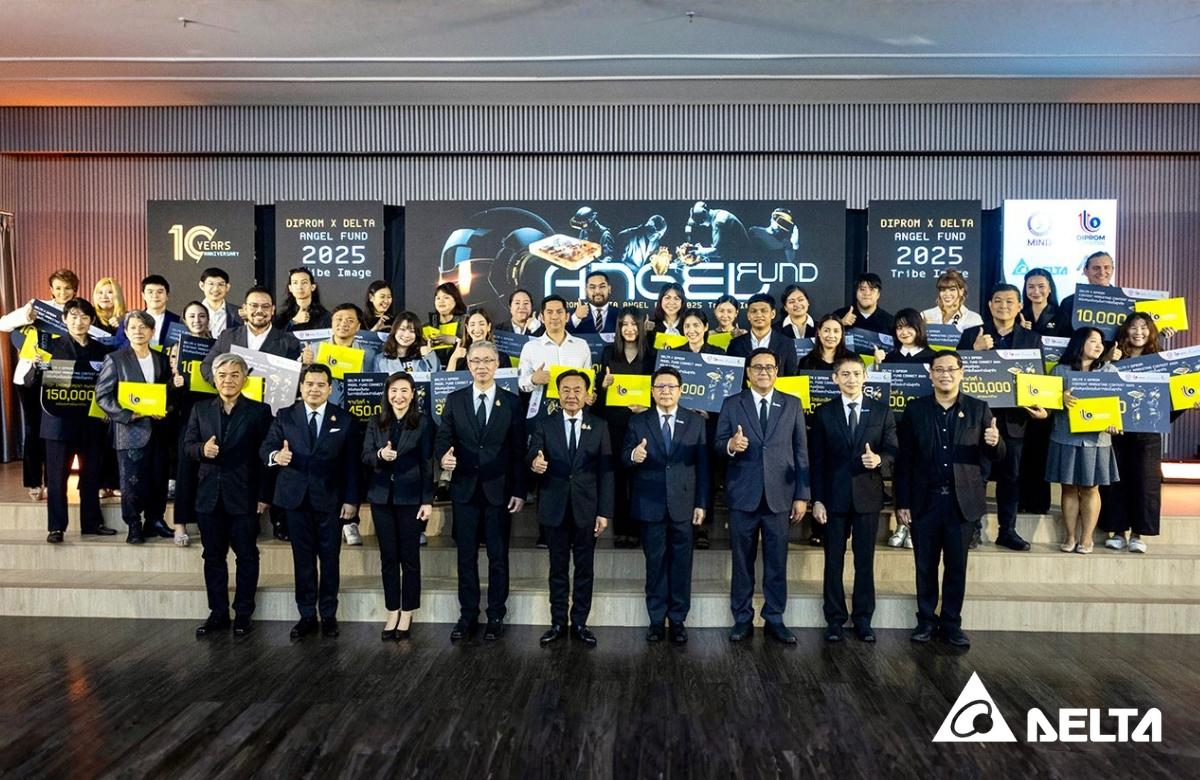
Angel Fund Project
Delta Thailand together with the Department of Industrial Promotion (DIPROM) under the Ministry of Industry, celebrates the 10th anniversary of Delta DIPROM Angel Fund, a program that has strengthened Thailand’s startup ecosystem through innovation, sustainability, and global collaboration. Since its launch in 2016, the program has supported more than 200 startups with THB 33.16 million in funding, generating THB 350 million in economic value, facilitating THB 115 million in business expansion, and creating 927 new jobs nationwide. This year’s edition, titled “Angel Fund Connect 2025,” continues this legacy by expanding the program’s reach to include both startups and content creators working together to drive innovation and digital engagement.
Education Support Program
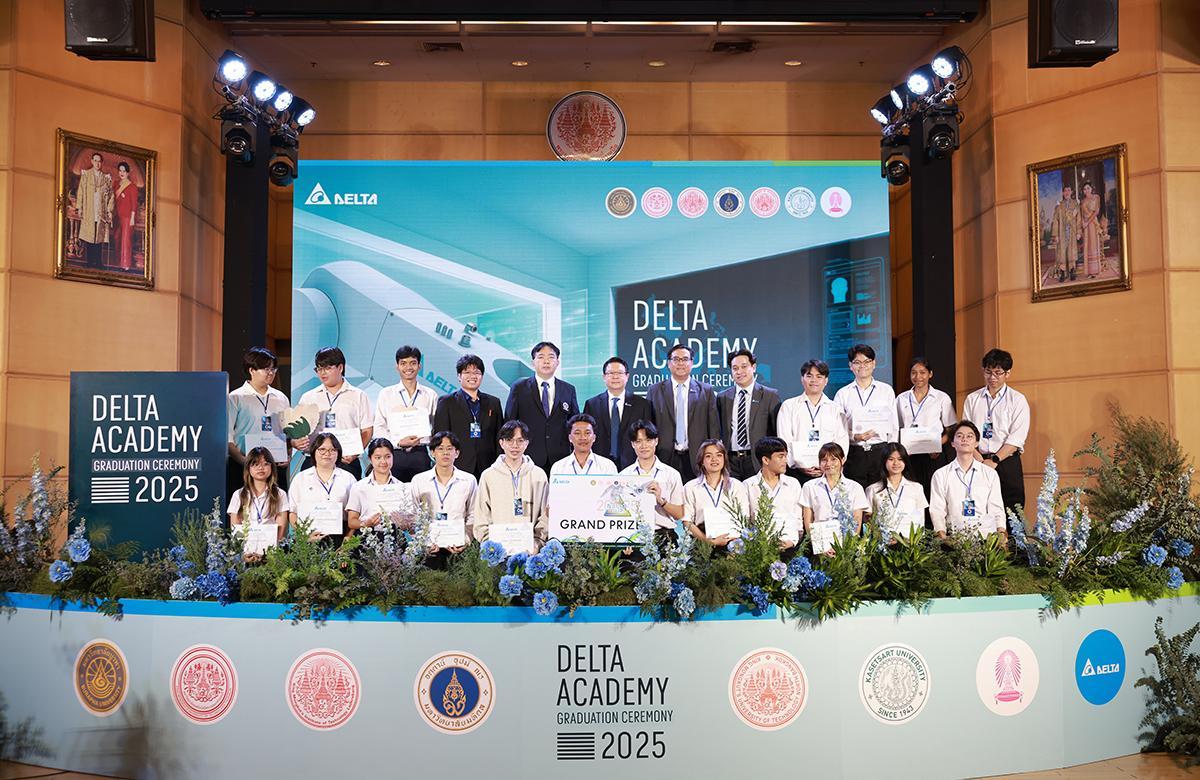
Delta Academy Program
The Delta Academy program directly supports the Thai government’s vision for Thailand 4.0 and the 20-Year National Strategy. The initiative also contributes to Thailand’s plan to develop 280,000 high-tech professionals within five years. In line with the National AI Master Plan 2021–2027, Delta upgraded Programmable Logic Controller (PLC) and Human Machine Interface (HMI) systems at partner universities in 2025, ensuring students gain hands-on experience with the latest automation technologies relevant to emerging industries such as AI and data centers.
Delta Cup
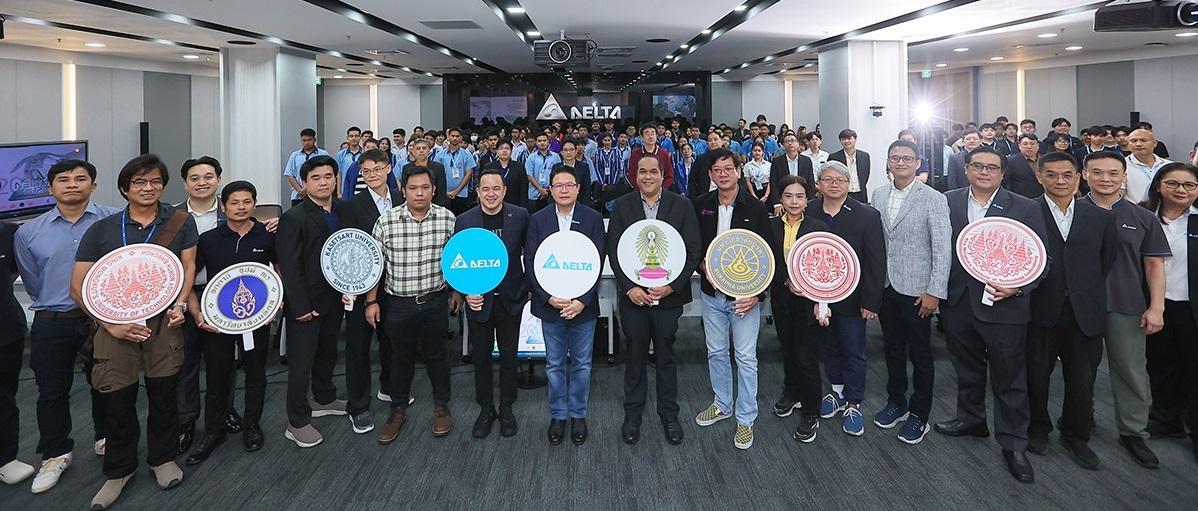
Delta Electronics (Thailand) Hosts Delta Cup 2025 to Drive Innovation and Talent Development for a Smarter, Greener Industrial Future, bringing together 72 engineering students from seven of Thailand’s leading universities to compete in the second year of the competition. The event has become a premier platform for advancing innovation, technical skills, and collaboration between academia and industry.
Delta Power Electronics Lab Program
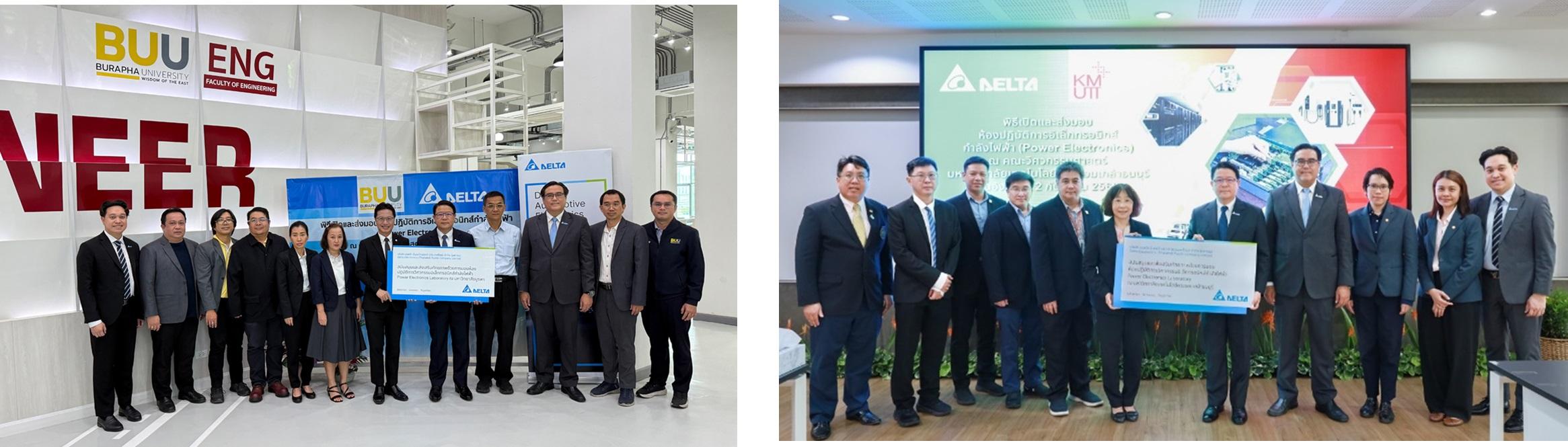
Delta Power Electronics Lab Program is an initiative to establish world-class power electronics laboratories across Thailand’s top engineering institutions, providing students nationwide with access to a modern learning environment that supports innovation development and strengthens industry-relevant practical skills. In this year, the fifth and sixth laboratories were delivered to the Faculty of Engineering at Burapha University and the Faculty of Engineering at King Mongkut’s University of Technology Thonburi.
Future Talents Program
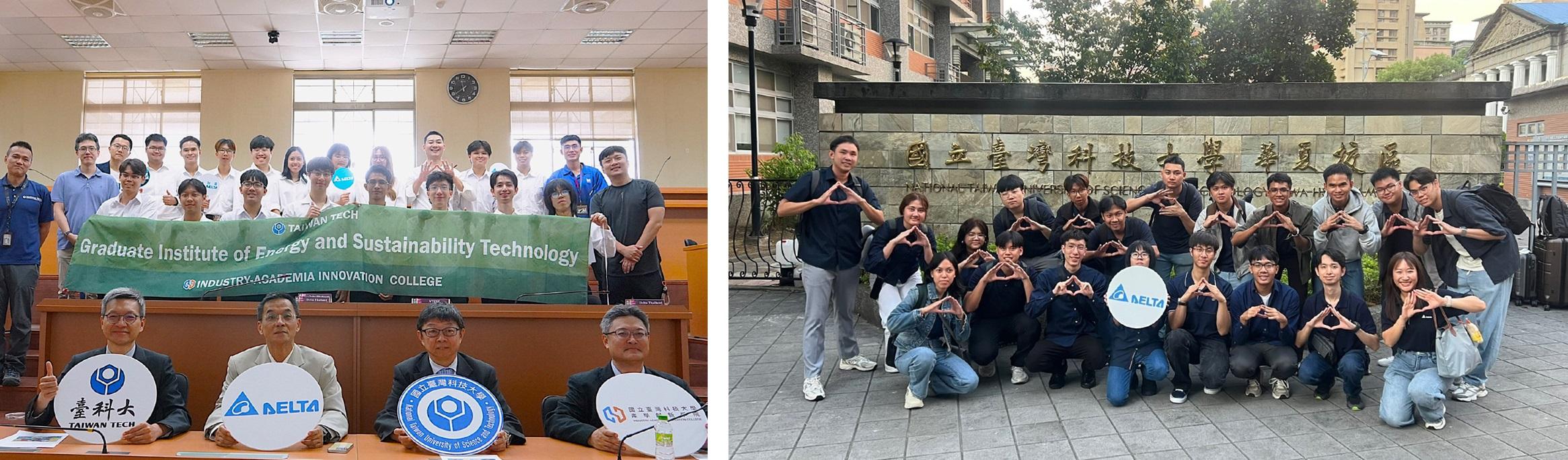
Delta Thailand nurtures next generation of Thai engineers to drive global power electronics innovation. Delta is fully sponsoring their two-year master’s program in Power Electronics at National Taiwan University of Technology (NTUST). Upon graduation, the students will continue their professional journey at Delta Thailand’s expanding R&D Center.
Delta Energy Education Program (DEEP)
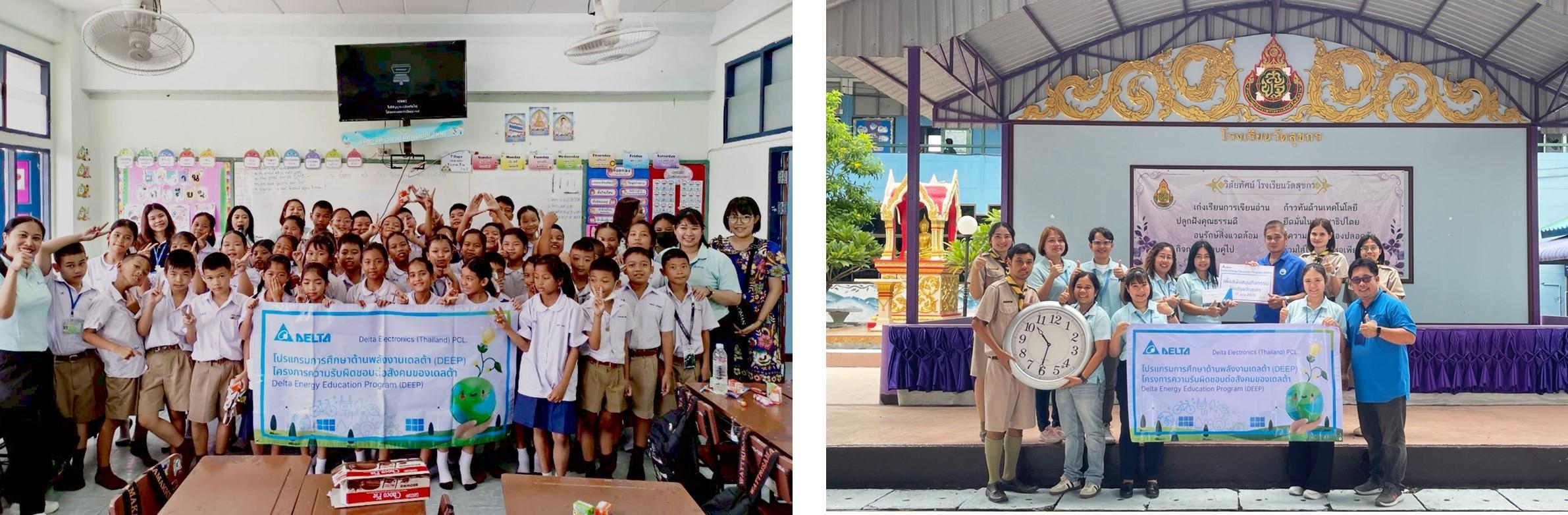
Delta Thailand continued its commitment to sustainability and community development through the Delta Energy Education Program (DEEP), an initiative designed to promote energy literacy among young learners through interactive sessions focused on responsible energy use, renewable energy, and conservation practices.
Inspiring Innovation for Mega Trends 2025
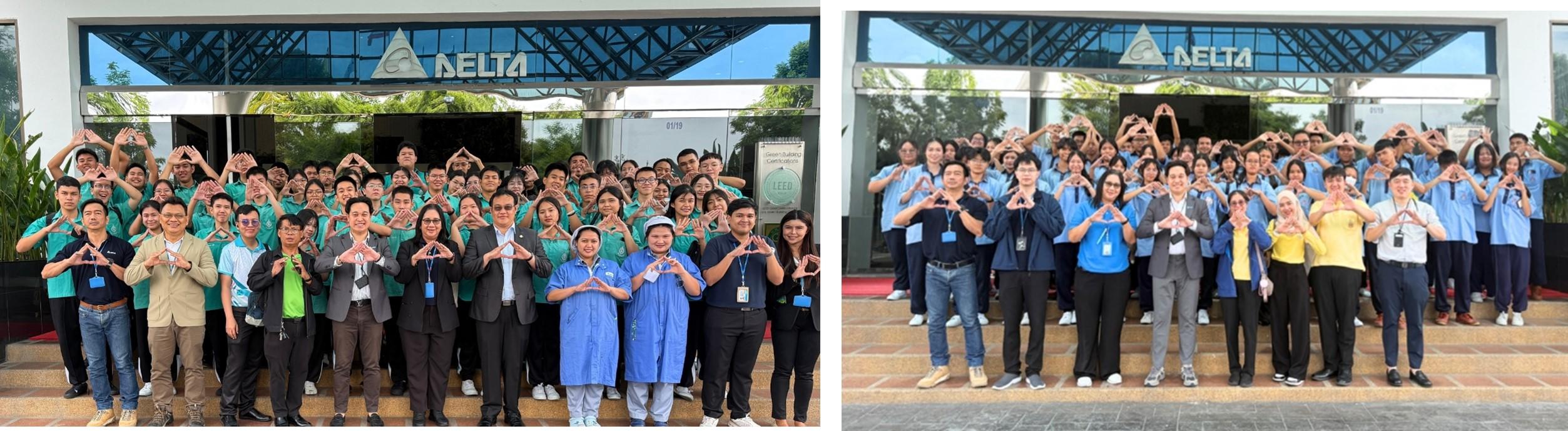
Delta Thailand delivered an interactive learning experience under its Inspiring Innovation for Mega Trends 2025 initiative. The program supports Delta’s broader mission to promote STEM capabilities and develop future-ready talent in sustainability and innovation. The visit served as a valuable platform to spark curiosity, foster creativity, and ignite a passion for technology. By engaging directly with Delta’s experts and learning about innovations that address global megatrends, students gained valuable insight into potential career paths in Engineering, Information Technology, and other STEM disciplines.
Natural Resource Conservation
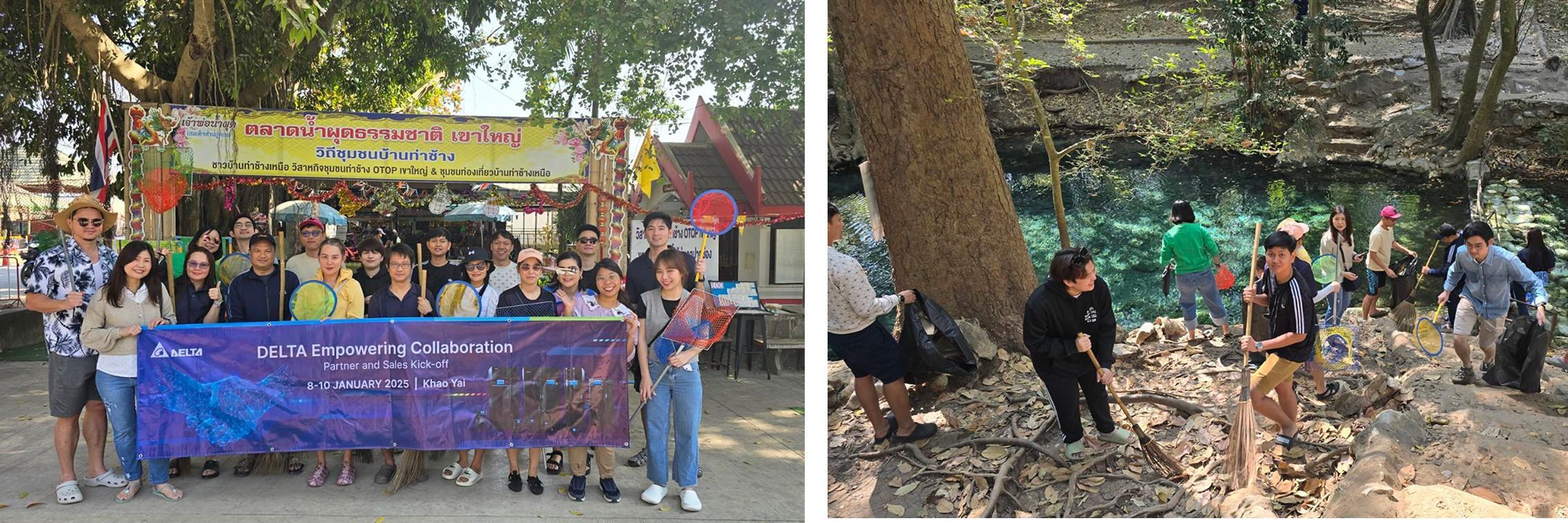
Delta Green Thailand demonstrated its unwavering commitment to environmental sustainability through its latest CSR initiative, “Clean Up and Conserve Nature.”, at the scenic Ban Tha Chang Natural Spring in Nakhon Ratchasima, the event brought together employees, and customers to restore and preserve this vital natural resource. Beyond cleaning, the initiative aimed to foster environmental responsibility among visitors and the local community. By highlighting the importance of proper waste disposal and sustainable practices.
Promotion of Health and Quality of Life
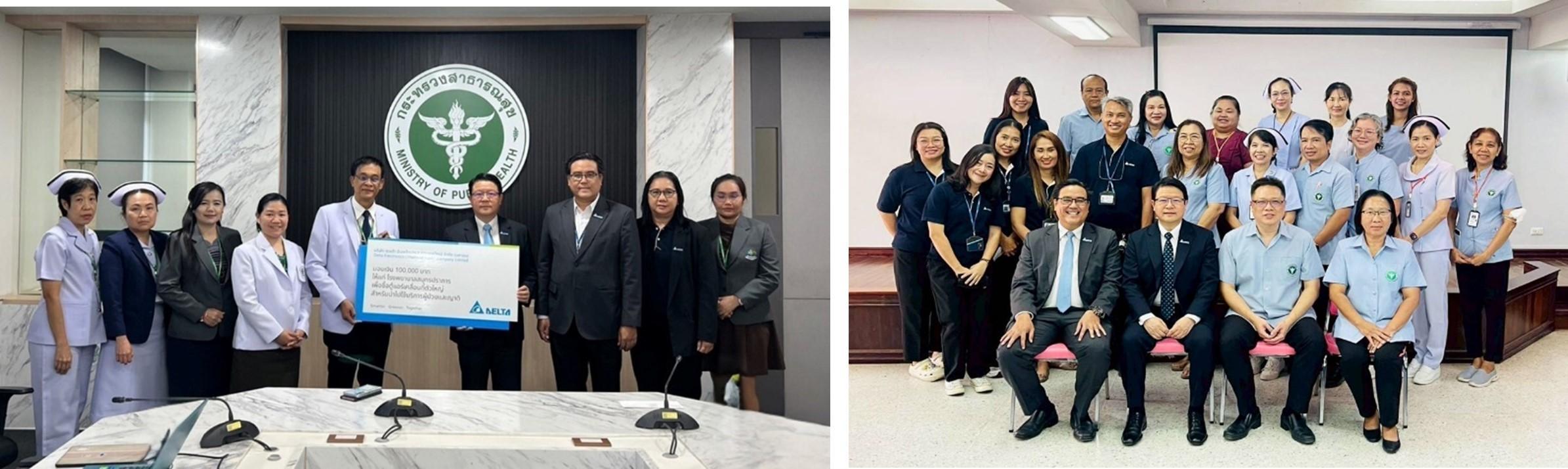
Delta Thailand donated funds to Samut Prakan Hospital, Bang Pakong Hospital, and the Bang Pakong District Public Health Office to support the procurement of essential medical equipment. The contribution will help strengthen the hospitals’ healthcare service capabilities and aligns with Delta’s mission to promote public health and sustainable development in Thailand.
Reducing inequality
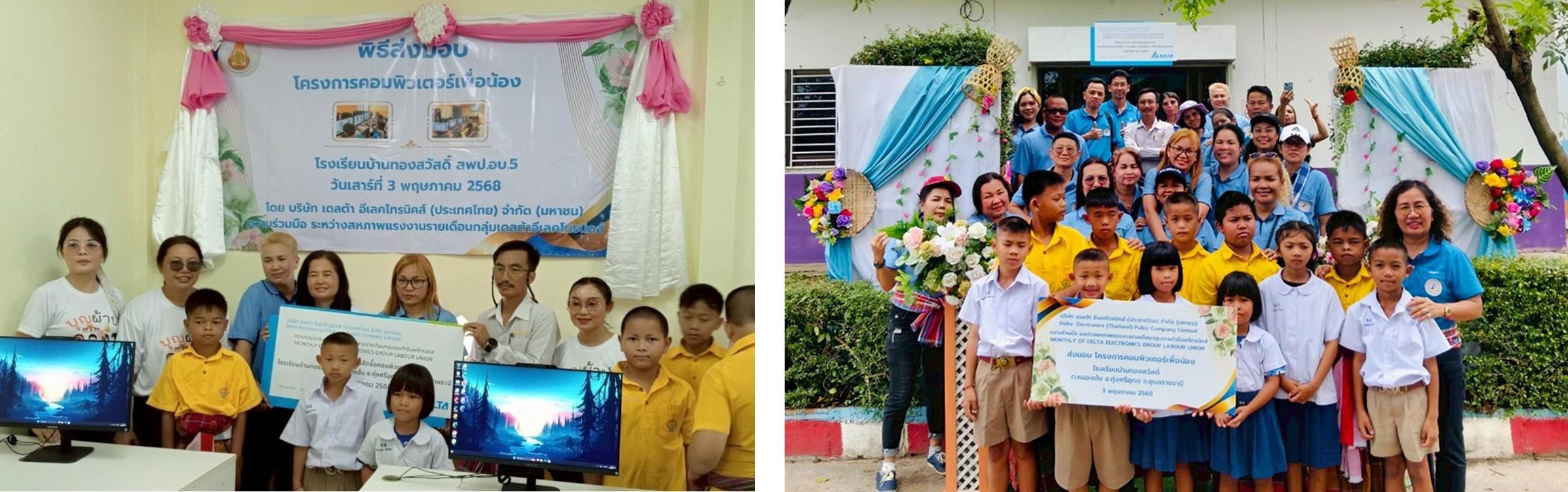
Delta Thailand promotes educational equity through technology under its corporate social responsibility (CSR) initiatives by donating multiple desktop computer sets to Ban Thong Sawat School in Nong Om Subdistrict, Thung Si Udom District. The donation supports the advancement of digital education in remote areas, enabling schools to develop educational technology on par with urban institutions. Bridging the digital divide in rural communities not only enhances the quality of education today but also lays a strong foundation for Thailand’s long-term human capital development.
Plan Areas
| Plan Area |
|---|
| Employment and professional skill development |
| Education |
| Forests and natural resources |
| Occupational health, safety, health, and quality of life |
| Reducing inequality and promoting social equality |
Community & Social — Targets
Has Set Community & Social Targets
Yes
Targets
| Indicator | Target Areas | Base Year | Base Year — Description | Target Year | Target Year — Description |
|---|---|---|---|---|---|
| CSR activities with schools | 3045 · Other name: Infrastructure development for rural schools · Description: Others | 2,025 | 8 Project/Year | 2,025 | 8 Projects/Year |
Community & Social — Performance & Outcomes
Has Performance Results
Yes
Performance Description
In conducting business with responsibility toward communities and society, the Company places importance on minimizing environmental impacts and avoiding operations that may cause negative effects on the quality of life of communities surrounding its facilities. In 2025, there were no community complaints regarding social or environmental issues. In addition, the Company contributes to improving quality of life and promoting community engagement. In 2025, the Company carried out the following community support activities:
Career Development Program
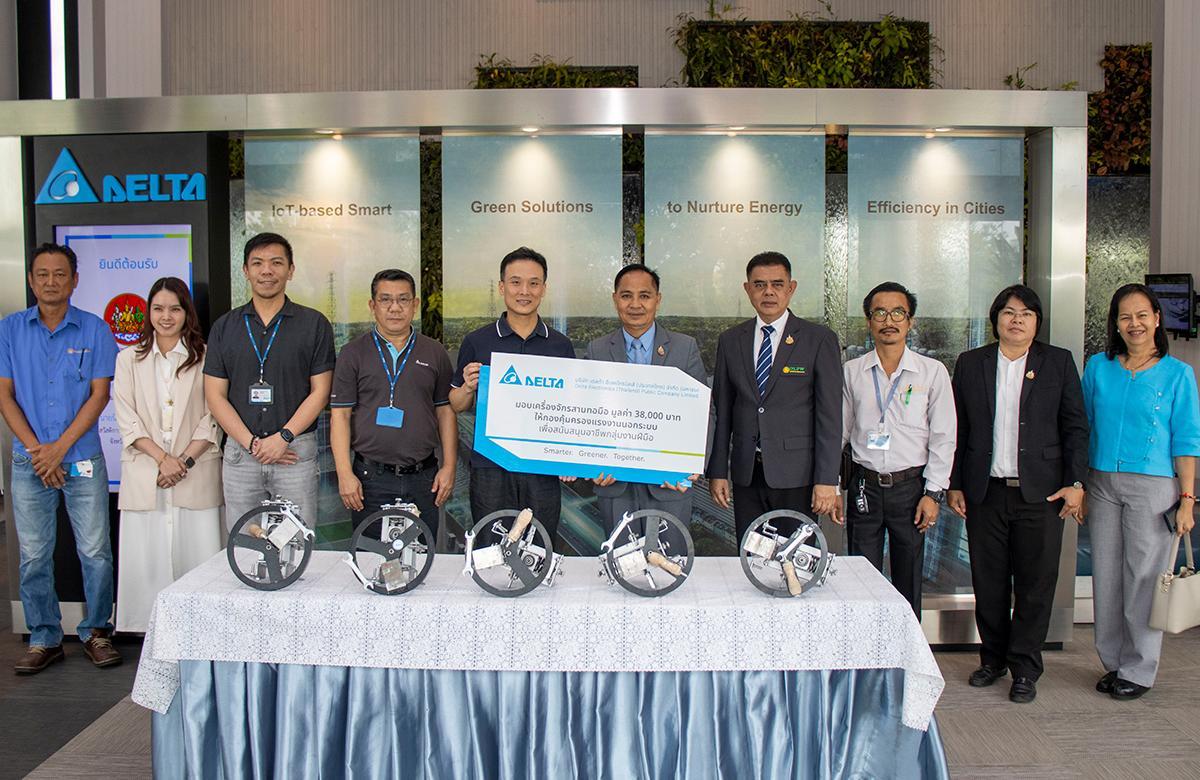
Delta Thailand recently donated over 11 hand-weaving machines to the Department of Labour Protection and Welfare in support of the Uthai Thani Informal Workers Club. The donation will directly benefit the Ban Nong Makok Bamboo Weaving Group, a community enterprise under the Uthai Thani Informal Workers Club. The group comprises 150 members, with wider benefits extending to more than 200 additional individuals in the community. The introduction of weaving machines and bamboo-splitting tools is expected to transform the group’s operations. By increasing output, improving product quality, reducing raw material waste, and optimizing costs, members will be better equipped to meet customer demand and expand into new markets. These improvements are projected to raise monthly income by 1,500–2,000 THB per member, while creating stronger long-term prospects for business growth.
Promoting Student Welfare
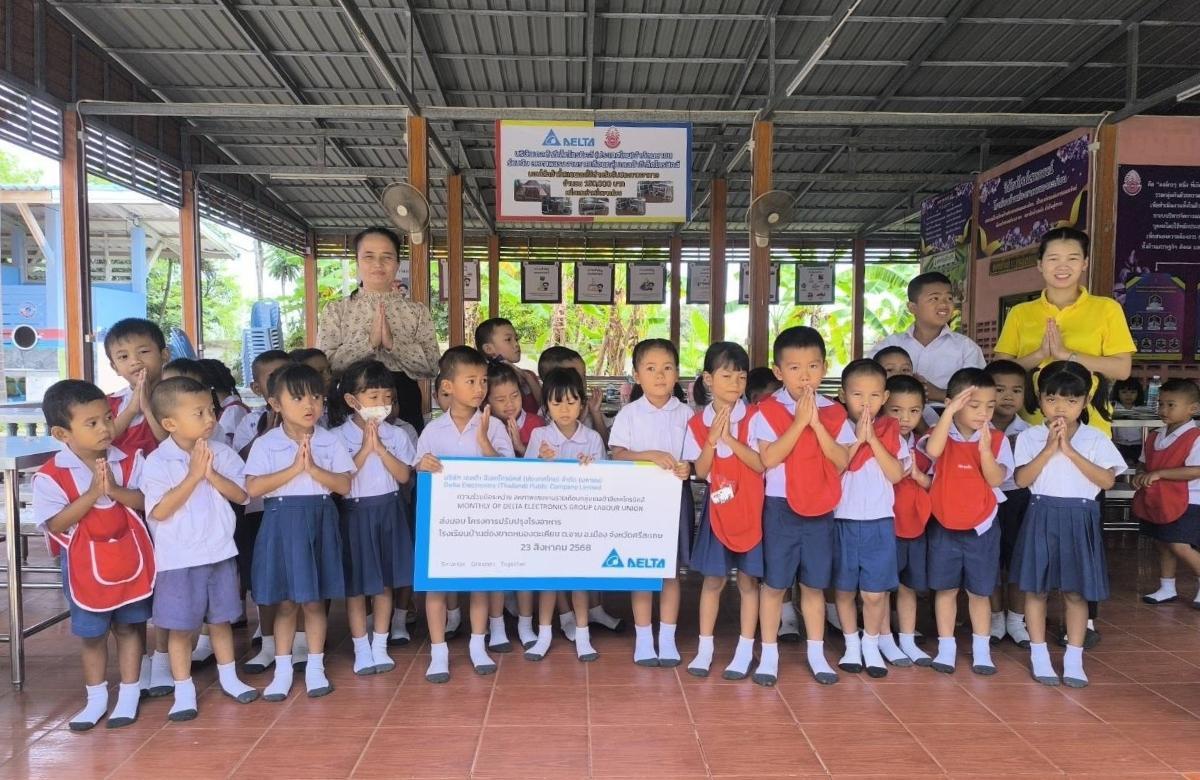
Delta Thailand, in collaboration with the Delta Electronics Labor Union, recently organized a Corporate Social Responsibility (CSR) activity at Ban Hong Khat Nong Takhian School, Sisaket Province. This initiative reflects a long-term commitment to supporting education, developing community infrastructure, and encouraging employee participation in social development. These efforts contribute to enhancing students’ health and well-being, as well as improving learning effectiveness. This project marks the 8th initiative under the 2025 annual plan. In the coming year, the labor union will continue to implement eight CSR projects per year. Employees will be invited to participate by nominating schools through storytelling and selecting eight schools to receive direct support. This approach helps foster transparency, inclusiveness, and active employee engagement in the project selection process.
Law Violation Incidents
Law Violation Incidents
| Metric | Current Year | Previous Year | Two Years Ago |
|---|---|---|---|
| The total number of cases or incidents of significant violations of laws or regulations regarding social and human rights (Cases) | 0 | 0 | 0 |
| The total number of cases or incidents that cause significant labor disputes (Cases) | 0 | 0 | 0 |
| The total number of cases or complaints related to consumer rights violations (Cases) | 0 | 0 | 0 |
| The total number of cases or complaints related to partner rights violations (Cases) | 0 | 0 | 0 |
| The total number of cases or incidents that cause disputes with the community/society (Cases) | 0 | 0 | 0 |
| The total number of cases or incidents related to cyber security or customer data breaches (Cases) | 0 | 0 | 0 |
| The total number of cases or incidents related to safety and occupational health at work (Cases) | 0 | 0 | 0 |